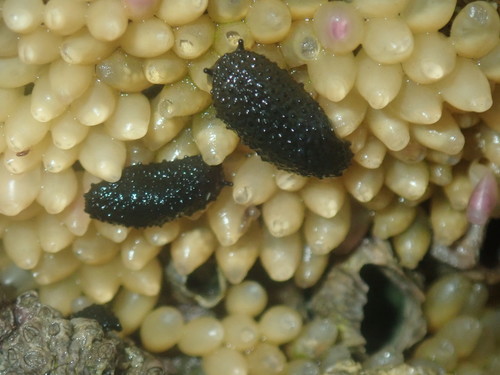
About Onchidella celtica (Audouin & Milne-Edwards, 1832)
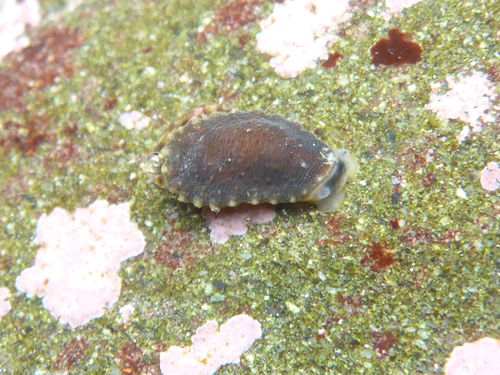
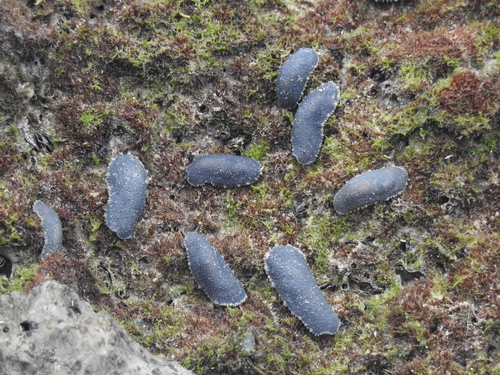
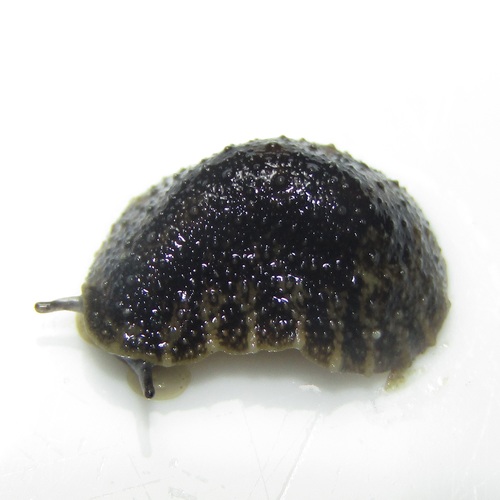
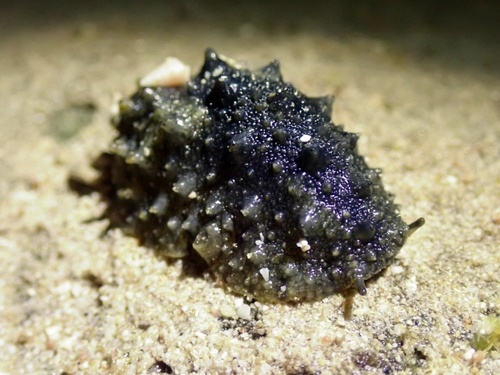
Onchidella celtica reaches a maximum length of 12 millimeters, and has an oval-shaped body that ranges in colour from deep olive to black. Its mantle is covered in large tubercles that hide the animal’s head and foot when it is not moving. The eyes sit at the tips of two short, thick tentacles, and are visible from above when the animal is crawling. This species is found locally along the East Atlantic coastline, ranging from western Scotland, western England and the Channel Islands south to Spain and the Azores, including the coastlines of Great Britain and Brittany. This air-breathing sea slug inhabits the intertidal zone on rocky shorelines. It is exposed on rocky shores at low tide, and retreats into crevices when the tide rises. It can absorb small amounts of oxygen through its mantle, which allows it to stay submerged during high tide. However, this secondary form of breathing does not allow it to be active underwater. Onchidella celtica hibernates during the winter. It lives gregariously in sheltered crevices during high tide, and travels to feed during high tide. This species has a "homing" ability: it returns to the same crevice with every high tide. This sea slug feeds on small algae and diatoms. Sand and detritus are taken in while feeding, and act as a physical aid to help grind food during digestion. When disturbed, Onchidella celtica can squirt out a repulsive substance. This species is hermaphroditic, and uses reciprocal mating to produce between 60 and 100 tubular eggs grouped together in a jelly mass. It reproduces during the summer, and newly hatched individuals resemble small adults.