About Omphalotus subilludens (Murrill) H.E.Bigelow
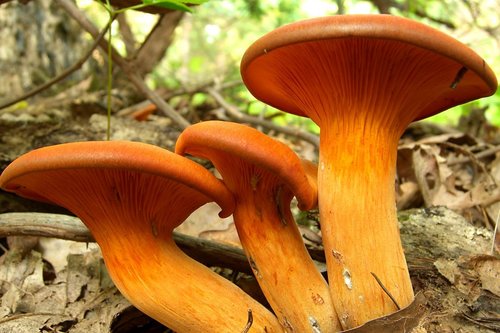
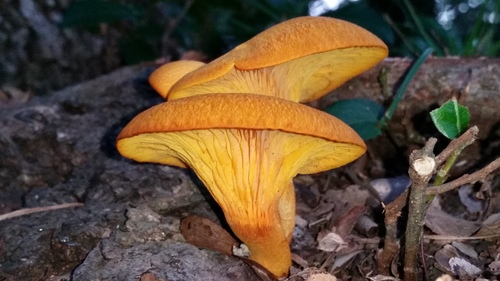
Omphalotus subilludens is a mushroom that produces fruiting bodies on dead and dying wood during spring, summer, and fall. Most observations of this species are recorded in late summer and fall. Its basidiocarps grow in clusters, and have an unpleasant smell and unpleasant taste. The mushroom’s pileus has an orange to dark reddish brown surface, with a convex to subexpanded shape that is depressed to cone-shaped at the center. The pileus can reach up to 15 cm wide. Its surface texture is either glabrous, smooth, or wrinkled, and the margin can be even, undulate, or lobed. The pileipellis contains refractive hyphae and an orange to brown encrusting pigment. The gills may be bioluminescent, and range in color from orange and orange-brown to reddish brown, darkening as they age. The gills are decurrent and tightly packed near the pileus margin. The stipe is deep yellow to orange-yellow, and the interior context matches this color. The stipe is firm, often eccentrically placed, subequal, marked with longitudinal lines, and has a glabrous texture. O. subilludens has a tetrapolar mating system. Its spores are white, smooth, and ellipsoid, elongated, or ovoid in shape. One source reports spores measuring approximately 7-9 micrometers by 5 micrometers, and no cystidia are present on the basidia. A second source reports an average spore length of 7.0±0.5 micrometers, ranging from 6.3 to 8.1 micrometers, and an average spore width of 4.8±0.3 micrometers, ranging from 4.2 to 5.8 micrometers. Spore morphology is a key characteristic used to distinguish O. subilludens from other Omphalotus species. O. subilludens is a saprobe that colonizes stumps and roots of dead and dying hardwoods and palms. Some sources suggest the species specializes on palms, but both formal and informal observations contradict this claim, as the species has been found growing on a variety of wood types. It is commonly found in hardwood forests and suburban areas where dead and dying trees are present. More research is needed to fully understand the species’ life history. Confirmed specimens of O. subilludens have been collected from Florida and Texas, with possible unconfirmed observations reported from Arizona and Mexico. This species can cause poisoning in humans and animals. While poisoning is rarely life-threatening, illudins present in all Omphalotus species cause gastrointestinal distress, including symptoms like nausea, vomiting, diarrhea, and sweating. Poisoning symptoms can vary between Omphalotus species: for example, O. olearius has been associated with additional possible symptoms such as vertigo and drooling. However, there are no published species-specific poisoning reports for O. subilludens. O. subilludens is commonly mistaken for chanterelles, which grow in the same habitat.