About Omophoita personata (Illiger, 1807)
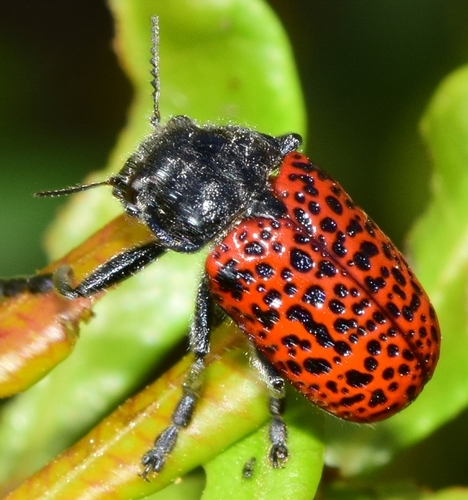
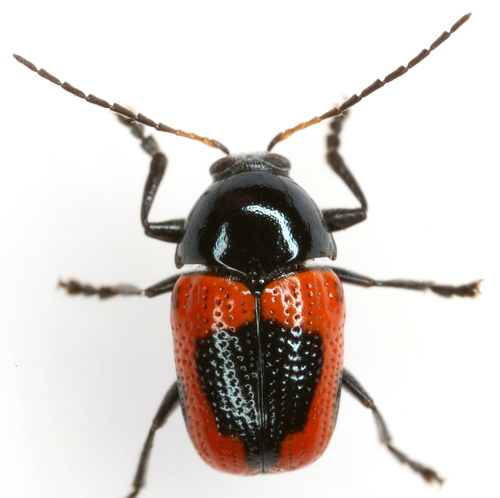
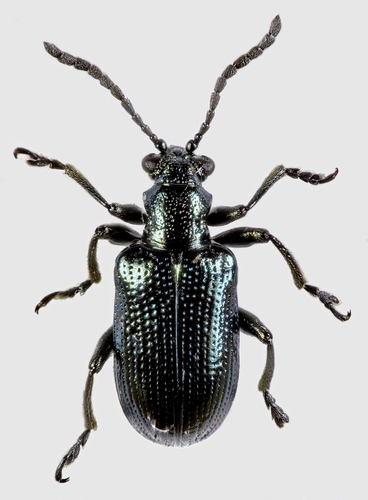
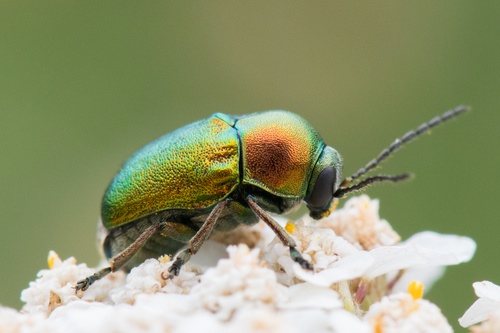
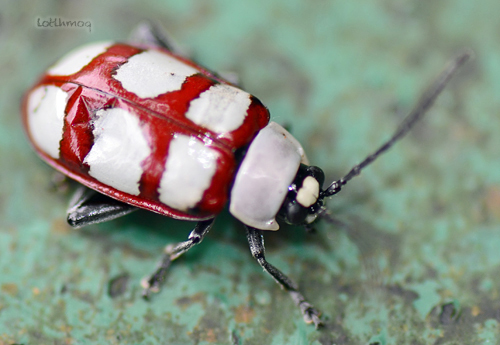
Based on Illiger's original description, Omophoita personata is one of the larger species in its genus. It measures over three lines long and has a nearly round body shape. This species displays the standard characteristics of the Oedionychina subtribe, including elytra that are either smooth or have confused punctuation, and well-developed hind legs with globose apical metatarsomeres. The original description also mentions its distinctive coloration, including a cream-colored head shield that is narrower than the wing covers, with outward-curving front corners. Immature stages of O. personata have been documented in detail by Antonio et al. (2022). Larvae of this species have bodies covered in tubercles and lack stemmata, or simple eyes; both traits are shared with other Oedionychina species. Larval development of O. personata proceeds through three instars, and the species completes its full development on its host plant. Third-instar larvae reach approximately 8 to 10 mm in length, and have the characteristic tuberculate body surface seen in all Oedionychina larvae. Omophoita personata is distributed across South America, with confirmed records from multiple regions of Brazil: the southern states of Paraná, Santa Catarina, and Rio Grande do Sul, as well as the Bahia region. For habitat and ecology, adult O. personata beetles have been observed feeding on Ocimum carnosum, a member of the Lamiaceae family, which acts as a host plant for both the species' feeding and reproductive activities. The species lives in a range of environments within the Neotropical region, and is known to occur in forested areas.