About Ommatotriton ophryticus (Berthold, 1846)
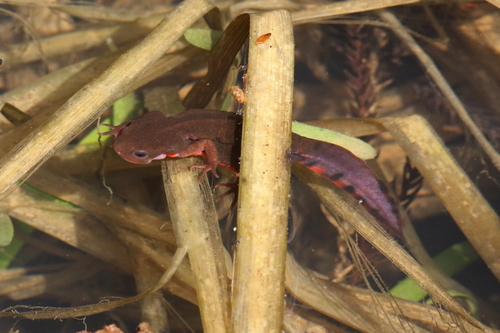
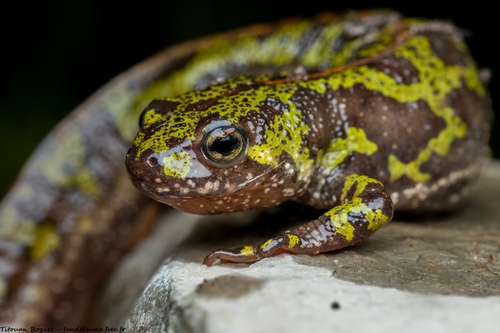
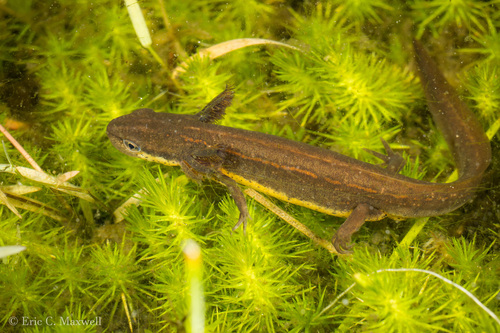
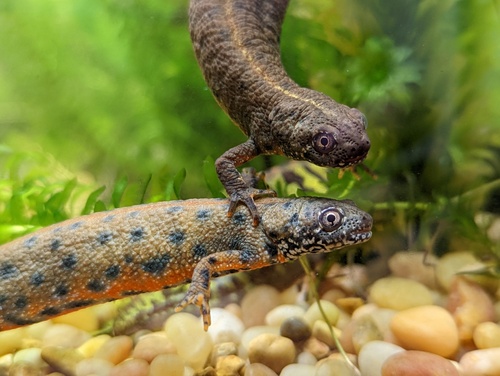
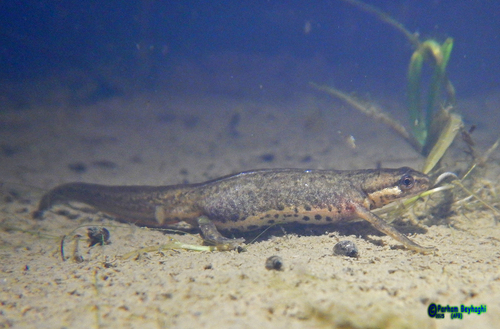
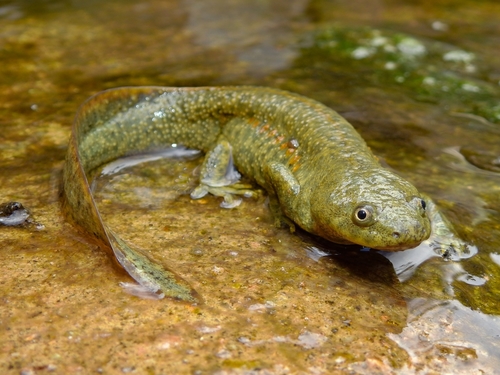
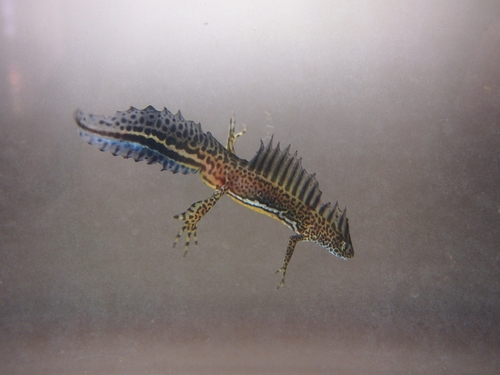
This species has a tail that is roughly the same length as its body and head combined. Its limbs and digits are long, and they are especially long in males. Its skin texture ranges from nearly smooth to slightly granular. During its terrestrial phase, the dorsal surface of its body is reddish. During its aquatic phase, the dorsal and lateral surfaces are bronze-olive or olive-brown; it has small dark spots on its back, and a light band on its flanks that is bordered by dark stripes. Its belly is an unmarked yellow to orange. During the breeding season, adult males grow a very high, notched crest along the middle of their back and tail. This crest has a yellowish or brownish base color marked with dark vertical stripes. Additionally, the top surface of the males' tails is covered with dark spots, while other parts of the tails have blue and/or greenish spots. Ommatotriton ophryticus is mostly found at elevations over 1,200 meters (3,900 feet) above sea level. It typically inhabits coniferous, mixed, and deciduous forests, and can range up into subalpine meadows. It reproduces across a wide variety of water bodies, from temporary ponds to lakes. It generally hibernates on land, though individuals in breeding coloration have been found in water as early as January. Its terrestrial habitat can be relatively arid. This species can be common in some local areas, but it has a sparse, scattered distribution across most of its range. It is threatened by habitat loss from forest destruction, dam construction, wetland destruction, overgrazing by cattle, urbanization, and pollution. Predation by introduced raccoons (Procyon lotor) is another major threat, and this species is also collected for the pet trade.