About Ommatoiulus moreleti (Lucas, 1860)
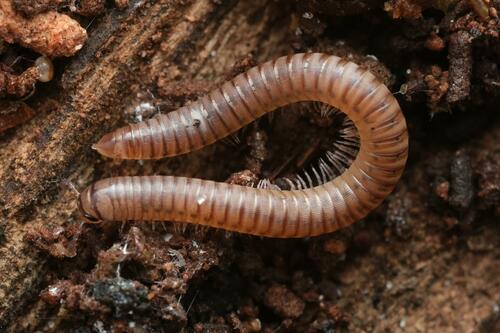
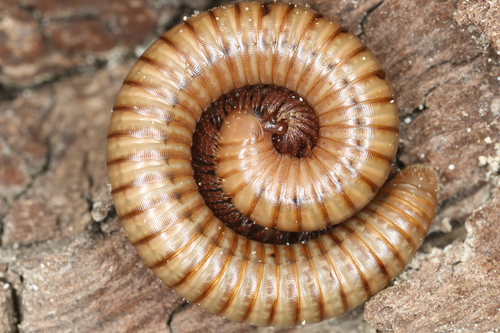
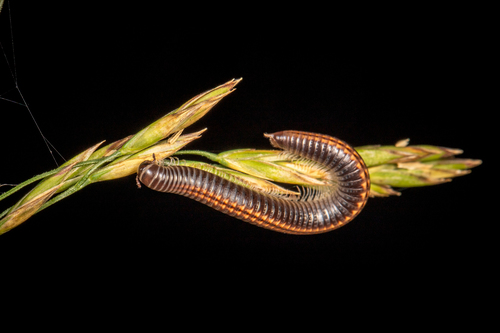
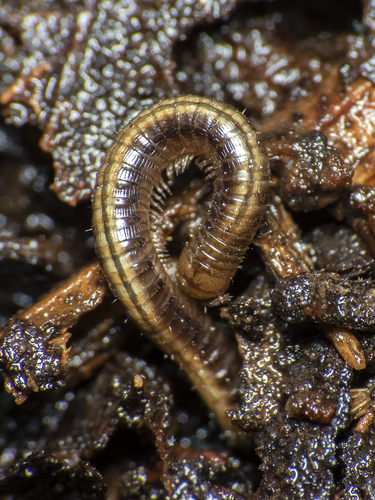
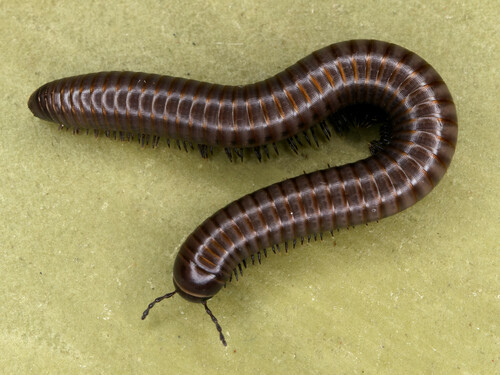
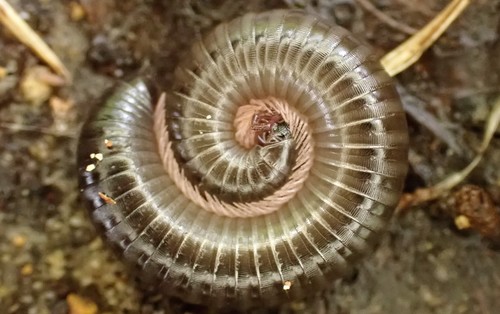
Ommatoiulus moreleti (spelled moreletii in some newer publications), commonly known as the Portuguese millipede, is a herbivorous millipede native to the western Iberian Peninsula, where it shares its range with other Ommatoiulus species. It has spread from this native region through international commerce to many new locations. The species was accidentally introduced into Australia without its natural enemies, and has since become an invasive pest. It has also been introduced into New Zealand. Several management methods have been developed for this millipede. O. moreleti is indigenous to the western Iberian Peninsula. It has spread to a number of Atlantic islands including Macaronesia and Bermuda, South Africa, Australia, and New Zealand. This observed distribution appears to be linked to 20th century shipping routes. Its ability to survive long sea voyages in a quiescent state may help it spread via international trade. In its natural habitat, the species survives long, dry summers in this quiescent state. After its initial introduction to South Australia around 1953, which likely came from ships’ ballast, the species continues to spread through southern Australia. It is possible that there has been more than one separate introduction to Australia. Since its 1953 introduction to Port Lincoln, South Australia, the millipede has spread to other parts of South Australia, Victoria, Tasmania, the Australian Capital Territory, southern New South Wales, and Western Australia around Perth. The species became established in New Zealand in the early 2000s. In the southern Iberian Peninsula, multiple species of the genus Ommatoiulus share similar ranges but divide habitats based on litter type. This close grouping of related species suggests habitat partitioning acts to limit O. moreleti populations relative to other Ommatoiulus species. O. moreleti prefers tree litter, particularly litter from Quercus species (where densities of stage 7 or older O. moreleti reach about 5 per m²) and Pinus species. Other Ommatoiulus species replace O. moreleti in shrub litter or grassland habitats. In contrast, southern Australian grasslands hold densities of over 40 stage 7 or older O. moreleti per m². As an invading species in the southern Australian detritivore community, O. moreleti does not appear to have negatively affected native millipedes that share its range, and it seems to have occupied previously vacant niches. Reproductive females mature their eggs during late summer to early autumn, and mating occurs during the autumnal activity period. After mating, the female lays 60 to 80 eggs in a chamber 1 to 2 cm deep in the soil. Eggs hatch into a pupoid stage, then develop through a series of moults that produce up to 16 stages over 3 years. Males can be differentiated starting at the 8th and 12th stages, but most reach maturity by the 10th or 11th stages. Females likely mature at similar stages. One-year-old immatures (stages 7 to 9) are light brown with a darker medial stripe. After 2 years, 10th to 11th stage millipedes have turned black. Adult Portuguese millipedes are smooth, 20 to 45 millimetres (0.8 to 1.8 in) long, and range in colour from grey to black. Millipedes older than 1 year only moult in spring and summer. Adult males are periodomorphic, alternating between a sexual and a non-sexual form. In their sexual form, they have gonopods (mating legs) on the seventh body segment; they lose these gonopods when they moult in spring. They remain in the non-sexual "eunuch" form until their late summer moult. Gut contents of mature O. moreleti collected in Portugal were predominantly fragments of Quercus and Pinus litter. However, the guts also contained significant amounts of fresh mosses and liverworts. O. moreleti can be raised in culture from egg to reproductive stage when fed solely on fresh mosses.