About Oliva sayana Ravenel, 1834
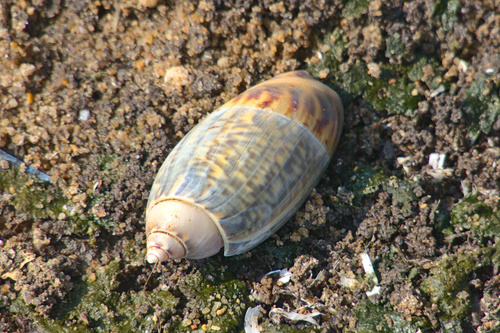
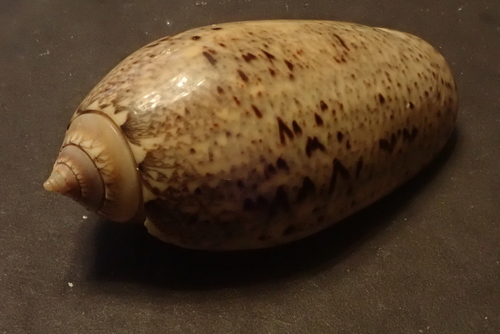
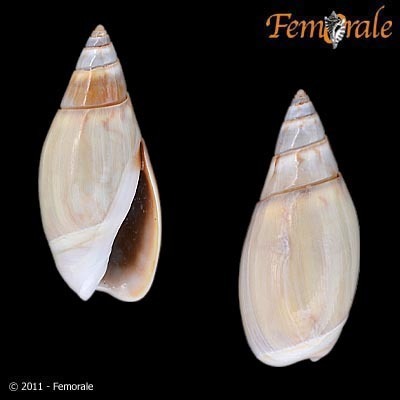
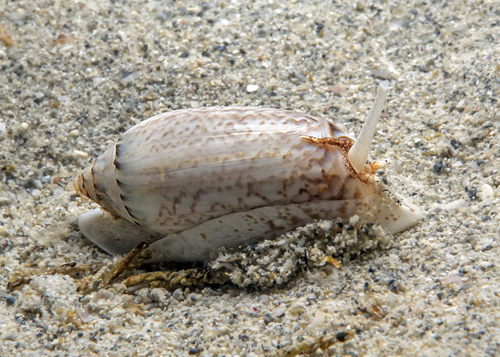
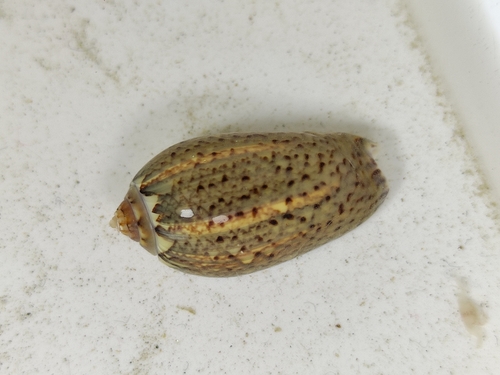
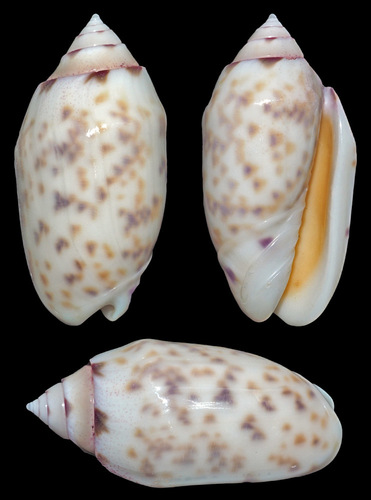
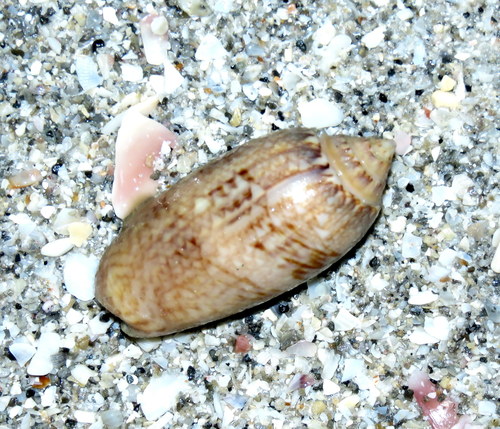
Oliva sayana Ravenel, 1834, commonly known as the lettered olive, has an adult shell that reaches around 6 cm (2+1⁄4 inches) in length, with a maximum recorded size of 9.1 cm. Its shell is smooth, shiny, and cylindrical with a short spire. The aperture is narrow, runs almost the full length of the shell, continues around the bottom, and ends in a notch on the opposite side. The suture is a deep V-shaped cut. Just above the suture, the lower portion of the whorl extends outward, then drops sharply at a shoulder into the suture. Shell coloration ranges from cream to grey on the exterior, marked with reddish-brown zigzag patterns. The common name of this species comes from the darker markings, which sometimes resemble letters. This species ranges along the North American coast from North Carolina to Florida, across the Gulf coast states including Louisiana and Texas, and extends south along Mexico’s east coast into Campeche State, Yucatán State, and Quintana Roo. It may also be found in Brazil. The lettered olive typically lives in near-shore waters, on shallow sand flats near inlets. Empty shells of this species are occasionally or commonly washed onto ocean beaches. Early Native Americans and colonists used these shells to make jewelry. The lettered olive is the official state shell of South Carolina.