About Oligodon arnensis (Shaw, 1802)
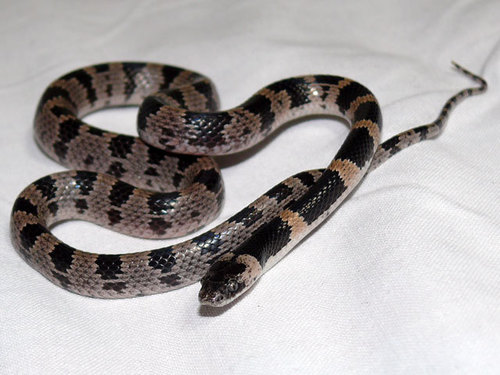
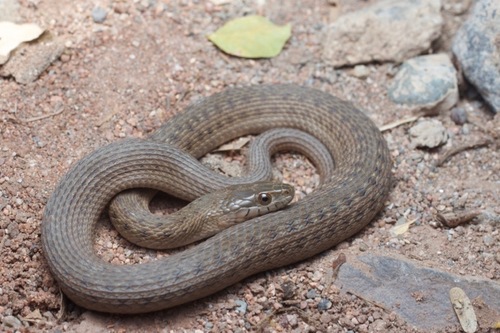
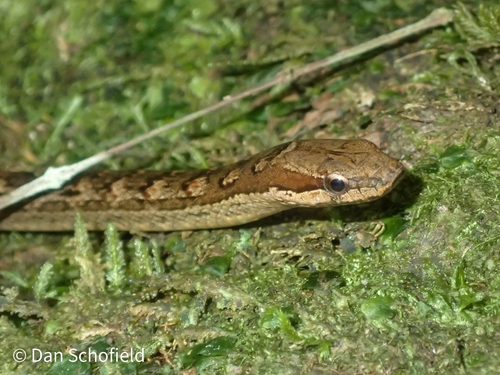
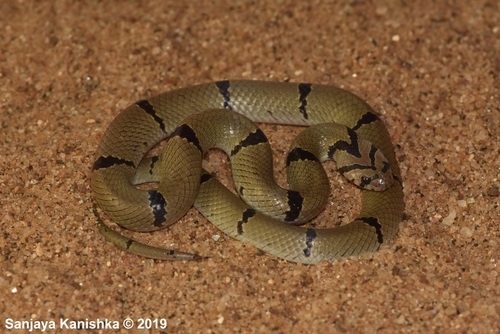
Oligodon arnensis (Shaw, 1802), commonly called the banded kukuri snake, has the following morphological characteristics. For scale terminology, refer to snake scales. Its nasal scale is divided. The portion of the rostral scale visible from above is as long as its distance from the frontal scale, or a little shorter. The suture between the internasals is usually nearly as long as the suture between the prefrontals. The frontal scale is as long as its distance from the end of the snout, or a little shorter, and is a little shorter than the parietal scales. If the loreal scale is distinct, it is longer than it is deep, and it is frequently united with the prefrontal scale. This species has one preocular and two postocular scales, temporals arranged 1+2, seven upper labials with the third and fourth entering the eye, and four lower labials in contact with the anterior chin shields. Posterior chin shields measure one-half to two-thirds the length of the anterior chin shields. Dorsal scales are arranged in 17 rows. Ventrals are angulated laterally, and number 170 to 202. The anal scale is divided, and subcaudals number 41 to 59. The upper body of the banded kukuri snake is pale brown or orange, with well-defined black crossbands that vary in number and width between individuals, and may be edged with white. There is an angular or transverse black band between the eyes, a second black band behind this one with its apex on the frontal scale, and a third black band on the nape. The lower surface is uniform yellowish; it is rarely spotted with brown, or has a brown posterior border to the ventrals. Maximum total recorded length is 24 inches (640 mm for females), with a 3.5-inch (100 mm for females) tail. This species is nocturnal, and feeds on earthworms, insects, and larvae. It has been recorded at altitudes up to 4100 feet in the Himalayas. Its confirmed distribution includes Afghanistan, Bangladesh, India (specifically the states of Tamil Nadu, Delhi, Uttar Pradesh, Orissa, Andhra Pradesh, Madhya Pradesh, Gujarat, Bihar, West Bengal, Uttarakhand, Chhattisgarh, Goa, Kerala, Himachal Pradesh, Rajasthan, Maharashtra, and Karnataka), Nepal, Pakistan, and Sri Lanka, with its range extending north from India and Sri Lanka to Nepal and the Himalayas.