About Oligocottus rubellio (Greeley, 1899)
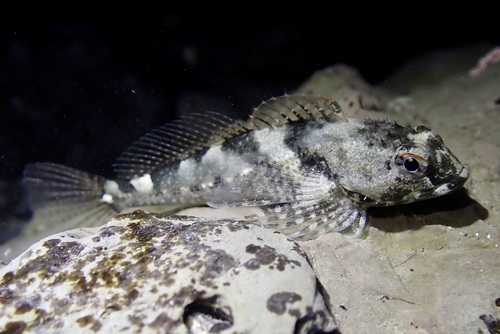
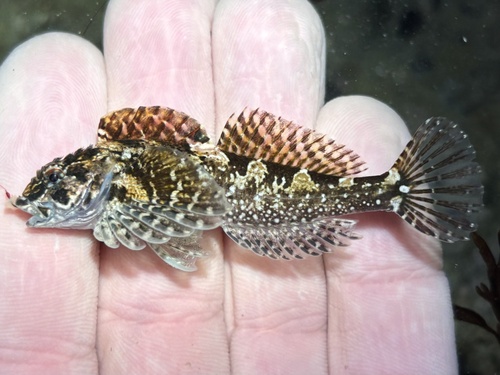
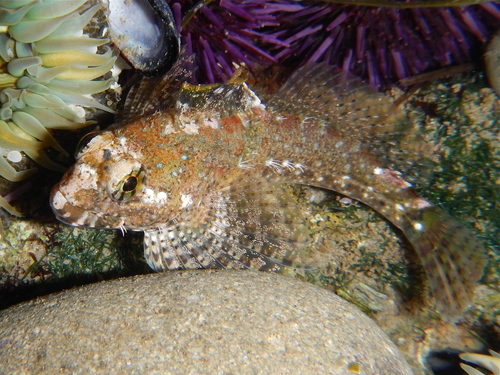
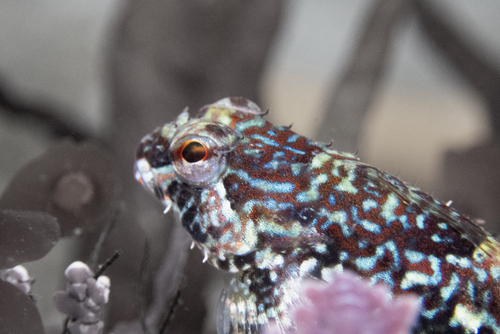
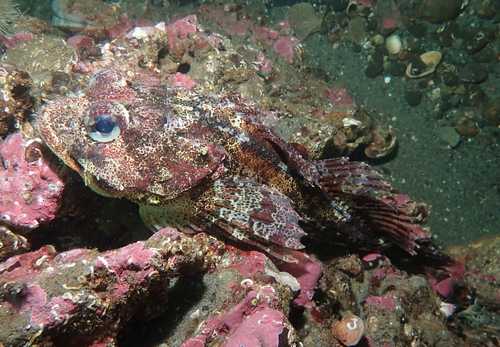
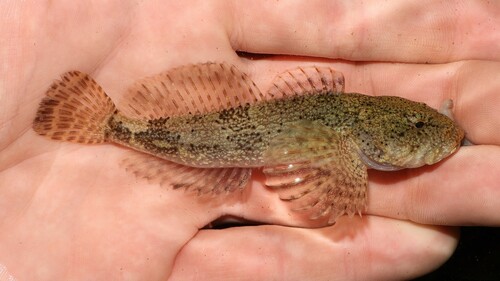
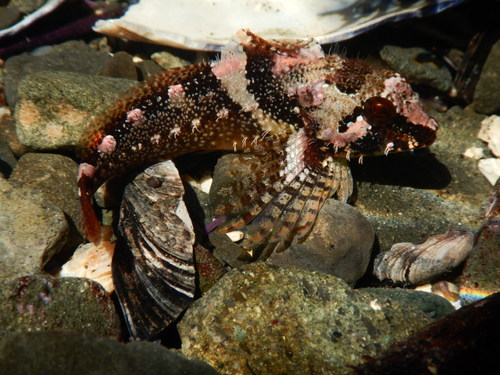
The rosy sculpin, scientifically named Oligocottus rubellio (Greeley, 1899), has a smooth, scaleless body with no prickles. Its nasal spine bears one cirrus, and up to four additional cirri are located on the rear of its jaw. Tufts of cirri grow along the base of the dorsal fin, along the lateral line, and on the head. The topmost spine on the preoperculum has between 2 and 4 points, with 3 being the most common count. The dorsal fin of this species contains 7 to 9 spines and 13 to 17 soft rays, while the anal fin is supported by 10 to 14 soft rays. The caudal fin has a rounded shape. The maximum published total length for this species is 10 cm (3.9 in). Its upper body ranges in color from reddish brown to pink or lavender, and its lower body ranges from greenish to brown. Dark saddle-shaped blotches run along its back, pale spots mark its flanks, and dark bars radiate out from its eyes. The rosy sculpin is distributed in the eastern Pacific Ocean, ranging from Fort Bragg, California south to Punta Baja, near El Rosario, Baja California. It inhabits rocky intertidal and subtidal zones, found at depths down to 34 m (112 ft).