About Oligocottus rimensis (Greeley, 1899)
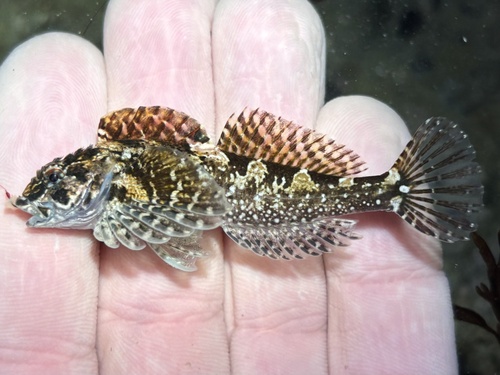
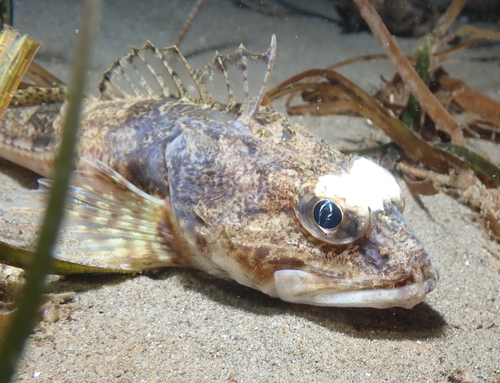
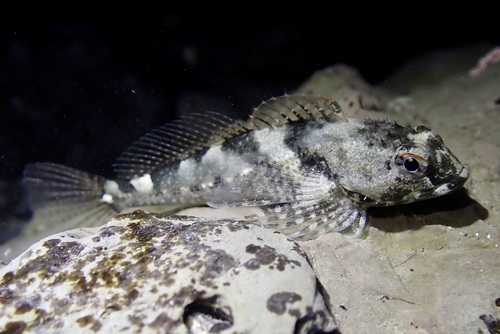
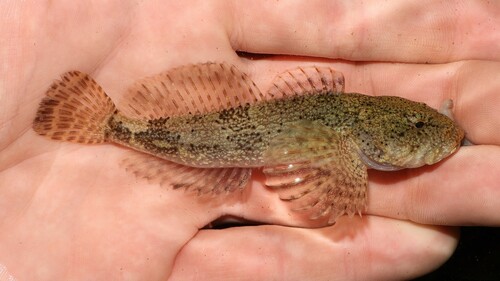
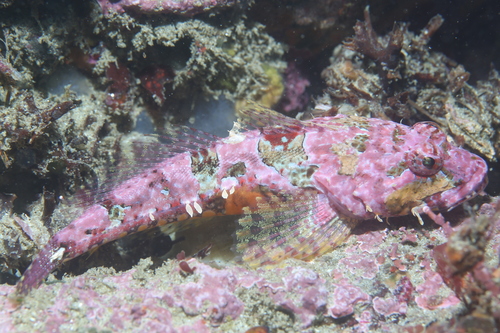
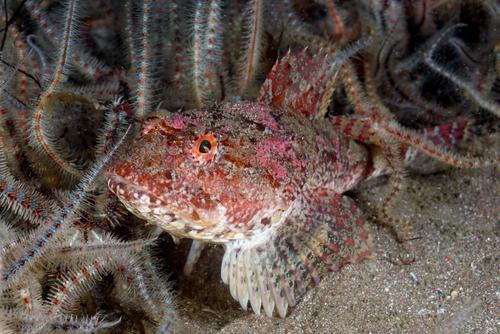
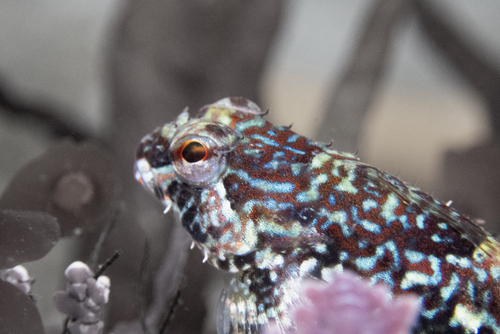
Oligocottus rimensis, commonly called the saddleback sculpin, is a small fish. Adults average 4 cm in length, and can grow to a maximum length of 6.2 cm. This species has an elongated body that tapers from a blunt, round head to the tail. It can be distinguished from other sculpins by two key identifying features: a single preopercular spine on the head, and small prickles that run along the entire length of the body. Saddleback sculpins have between five and six gill rakers, and their body is covered in papillae, with larger scales positioned laterally, usually in front of the body's pores. Their fin counts and shapes are consistent: the dorsal fin has 8 to 10 spines and 16 to 19 rays, the pectoral fin has 13 to 15 rays, the pelvic fin has 1 spine and 3 rays, the anal fin has 13 to 15 rays, and the caudal fin is slightly rounded. Their base color is olivaceous, with color shifting from red or green shades on the dorsal side to tan or green on the ventral side. Dorsal mottling forms five distinct saddle-shaped markings. The top of the head has a black spot, and a broken, sometimes branching band runs laterally along the length of the body. The saddleback sculpin is found along the west coast of North America, ranging from the subtropical region of Guerra Negro, Mexico, north to the temperate seas off Alaska. It prefers the lower intertidal zone, where it inhabits rocky substrates, kelp habitats, and eel grass. Research on this species is limited, so its actual distribution may be larger than currently documented, and there is evidence that it may also live in subtidal zones. Very little is known about the specifics of the saddleback sculpin's life cycle, due to the small number of studies focused on this species. However, related research has identified potential behavioral patterns. The species is thought to perform seasonal migrations, and occurs in much higher densities in the intertidal zone between November and February. This shift in density is not linked to changing food availability, so it is most likely tied to reproductive behavior. One leading theory holds that adult saddleback sculpins move to the intertidal zone to reproduce, because egg predation is much lower here than in subtidal zones. Unlike many other sculpin species, the saddleback sculpin does not stay in the intertidal zone year-round; it only occupies the intertidal seasonally, so it uses different habitats throughout the year. As an adaptation to variable habitats and the challenging conditions of the intertidal zone, the saddleback sculpin can breathe out of water, allowing it to survive for extended periods of time outside of water. This ability gives it a distinct advantage over competing species, and also offers better protection from its many predators.