About Olearia viscosa (Labill.) Benth.
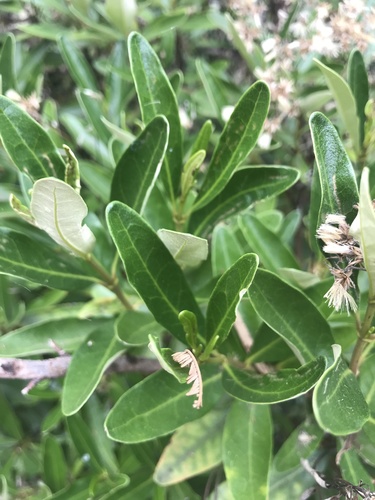
Olearia viscosa (Labill.) Benth. is a bushy shrub that usually grows to a maximum height of around 3 meters (9.8 feet). It has sticky branchlets that are more or less free of hairs. Its leaves are arranged in opposite pairs, and range in shape from lance-shaped to narrowly egg-shaped or elliptic. They measure 40 to 110 millimeters (1.6 to 4.3 inches) long, 10 to 40 millimeters (0.39 to 1.57 inches) wide, and grow on a short leaf stalk (petiole). The upper leaf surface is sticky or covered in resin glands, while the lower leaf surface is whitish or yellowish and covered in dense hairs. The daisy-like flower heads are arranged in moderately dense groups at the ends of branches. Each individual head is 8 to 15 millimeters (0.31 to 0.59 inches) in diameter, with a narrowly conical involucre 3.5 to 5 millimeters (0.14 to 0.20 inches) long at its base. Each head holds one or two white ray florets, with a ligule 3 to 7 millimeters (0.12 to 0.28 inches) long, that surround 3 to 5 yellow disc florets. Flowering takes place in November and December. The fruit is a ribbed, cylindrical achene 3 to 4 millimeters (0.12 to 0.16 inches) long, with a pappus 5 to 8 millimeters (0.20 to 0.31 inches) long. This species grows in forest habitat. It is widespread and reasonably common across Tasmania, especially in the southern part of the state. It also occurs in Victoria, where it is restricted to coastal scrub and rainforest edges near Lakes Entrance.