About Olearia tomentosa (J.C.Wendl.) DC.
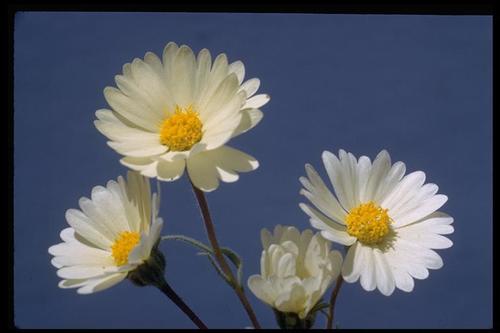
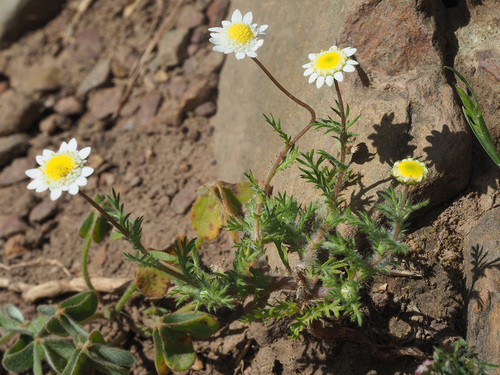
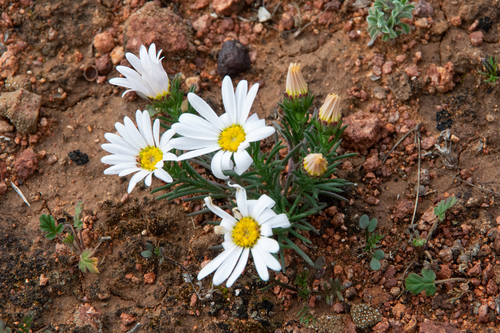
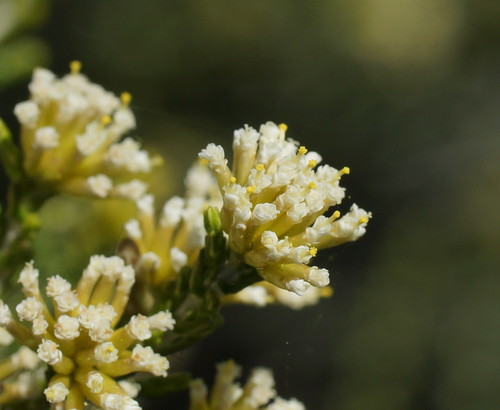
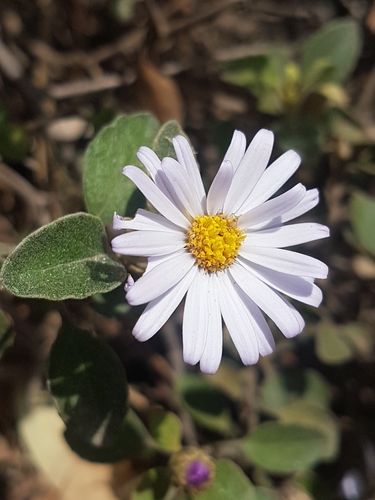
Olearia tomentosa, commonly known as toothed daisy-bush, is a spreading shrub that typically grows to about 2 meters (6 feet 7 inches) in height. Its branchlets are densely covered in rust-coloured hairs. Leaves are arranged alternately along the stems, are egg-shaped, and measure 10–85 mm (0.39–3.35 in) long and 9–50 mm (0.35–1.97 in) wide, borne on a petiole up to 15 mm (0.59 in) long. Leaf edges are toothed or lobed, and the lower leaf surface is densely hairy. The daisy-like flower heads are arranged singly or in small groups on a peduncle up to 70 mm (2.8 in) long. Each head is 25–59 mm (0.98–2.32 in) in diameter, with a bell-shaped involucre 7–10 mm (0.28–0.39 in) long at its base. Every head holds 12 to 33 white or blue ray florets, with ligules 12–25 mm (0.47–0.98 in) long, surrounding 30 to 90 yellow disc florets. Flowering occurs mainly from September to December. The fruit is a ribbed achene about 4 mm (0.16 in) long, with a pappus 7–9 mm (0.28–0.35 in) long. Toothed daisy-bush is distributed south of the Hastings River, inland as far as the Blue Mountains in eastern New South Wales, and east of Mallacoota Inlet in far eastern Victoria. It grows in sandstone-based soils in dry sclerophyll forest and heath. Most Olearia tomentosa plants are killed by bushfire, though there are reports of plants regrowing from suckers after fire. This species is not commonly seen in cultivation. It grows in well-drained soil in a sunny or partially shaded location. Regular pruning prevents the plant from becoming leggy and can rejuvenate older plants. The species is moderately frost-hardy.