About Olearia ramulosa (Labill.) Benth.
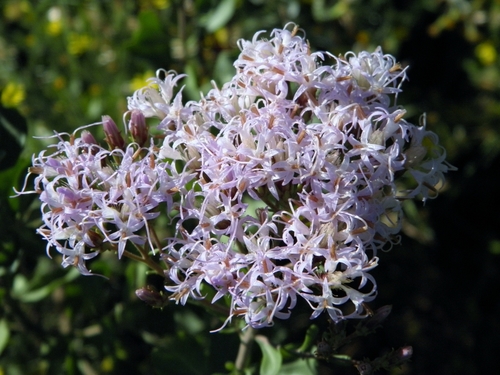
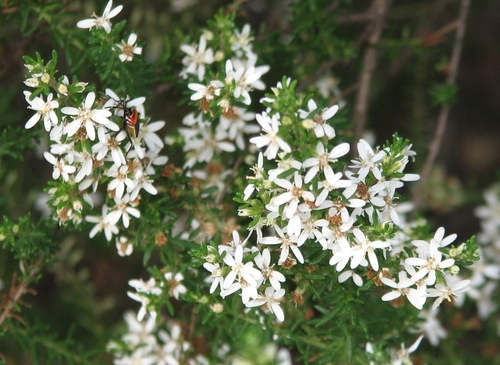
Olearia ramulosa (Labill.) Benth. is a shrub that typically reaches 1.6 meters (5 feet 3 inches) in height. Its leaves are alternately arranged along the stems, with shapes ranging from narrowly elliptic, linear to narrowly egg-shaped, where the narrower end is positioned towards the base. Leaves measure 2–8 mm (0.079–0.315 in) long and 0.8–2.5 mm (0.031–0.098 in) wide, with edges rolled under. The upper leaf surface is covered in minute pimples, while the lower surface is covered in grey, woolly hairs. The daisy-like flower heads are arranged either in leaf axils or at the ends of branches. They are either sessile, or borne on a peduncle up to 14 mm (0.55 in) long. The heads are 10–20 mm (0.39–0.79 in) in diameter, with a conical involucre 3–6 mm (0.12–0.24 in) long at the base. Each head holds 2 to 13 pale blue, mauve or white ray florets, surrounding 3 to 13 yellow disc florets. Flowering occurs between October and May, and the fruit is a silky-hairy achene, with a pappus that has 22 to 41 bristles. This species grows in forest, woodland and scrub, and is widespread and common across south-eastern Australia, ranging from south-eastern Queensland through New South Wales, the Australian Capital Territory and eastern Victoria to south-eastern South Australia and Tasmania. The plant is eaten by caterpillars of the moth Amelora milvaria. In a Tasmanian field study, bees and beetles were recorded visiting its flowers, with flies and wasps visiting less commonly. In horticulture, Olearia ramulosa can be propagated by seed, or by cuttings taken from hardened new growth. It grows well in dry or temperate climates, is frost-hardy, and can be planted in full sun or part shade. Pruning can invigorate the plant, and it can be grown as a low hedge.