About Olearia paucidentata (Steetz) F.Muell. ex Benth.
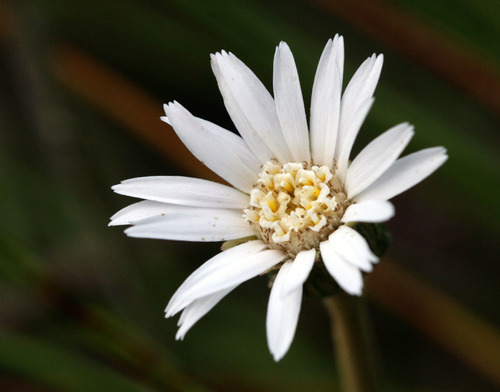
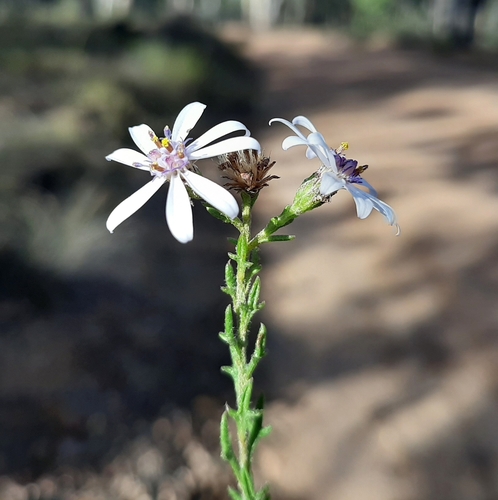
Olearia paucidentata, commonly known as autumn scrub daisy, is a shrub that typically reaches a maximum height of 1.2 m (3 ft 11 in). Its stems and leaves have a somewhat sticky texture. The species produces variably shaped leaves, most commonly elliptic, egg-shaped, spoon-shaped, wedge-shaped, or linear. Mature leaves measure 1–35 mm (0.039–1.378 in) long and 0.5–10 mm (0.020–0.394 in) wide, and grow from a petiole roughly 2 mm (0.079 in) long. Some leaves have up to four lobes along their edges. The daisy-like flower heads are arranged in panicles at the ends of branches, borne on a short peduncle. Each flower head is 10–25 mm (0.39–0.98 in) in diameter, with a conical, top-shaped, or cup-shaped involucre at its base. Every head holds 12 to 16 white, mauve, or blue ray florets, with a ligule 4.6–6.0 mm (0.18–0.24 in) long. These ray florets surround 13 to 56 mauve or yellow disc florets. Flowering can occur throughout the year. After flowering, the plant produces an achene fruit 1.0–1.2 mm (0.039–0.047 in) long. The pappus attached to the fruit has 21 to 33 long bristles and 10 to 16 short bristles. This species is widespread and common in the south-west of Western Australia, where it grows in open forest, most often in damp locations such as river banks and swamps.