About Olearia ledifolia (DC.) Benth.
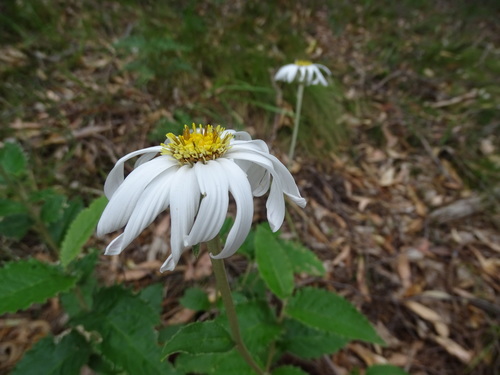
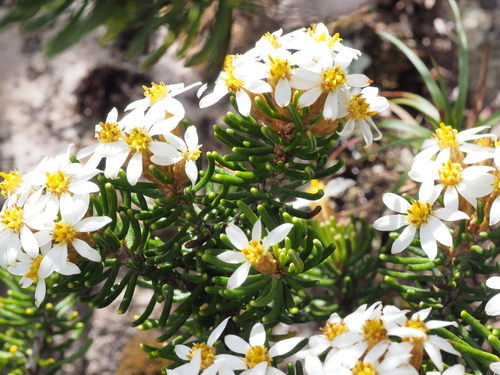
Olearia ledifolia (DC.) Benth. typically grows as a compact, low-lying, rigid shrub around 0.5 m (1 ft 8 in) tall. It produces numerous densely packed branches, with young growth covered in fine rust-coloured hairs. Lower sections of older branches often have raised scars left by leaves that drop off after one to two years. Its dark green leaves are tough and leathery, oblong in shape, measure roughly 12–14 mm (0.47–0.55 in) long, and are arranged alternately along the stems. The upper leaf surface is usually hairless, and leaf margins are rolled downwards and inwards. The lower leaf surface is covered in fine hairs that range in colour from rusty brown to silver. The daisy-like flower heads hold numerous florets, with involucral bracts at their base. Each head has 10 to 12 white ray florets with a ligule around 10 mm (0.39 in) long, surrounding deep yellow disc florets. Flower heads are borne singly on short peduncles in leaf axils near the tips of branches. The fruit is a shiny, hairless achene, and seed dispersal is aided by dry, wind-carried pappus. Flowering takes place in the southern hemisphere summer months of January and February. Olearia ledifolia is endemic to the Australian island state of Tasmania, and has also been recorded on King Island. It is a common species in alpine heath, bolster heath, deciduous heath, fjaeldmark, alpine sedgeland and coniferous heath at altitudes above 1000 m. Its common name, rock daisy bush, comes from its preference for sheltered rocky slopes and scree fields on mountain plateaus. At higher altitudes where tree growth is limited by climate, Olearia ledifolia may become a co-dominant species. The environments where it grows experience snow and ice, low temperatures, strong winds, and high UV levels. The main threat to the plant communities where O. ledifolia grows is fire: frequent burning greatly reduces the chance of community recovery and leads to lower species diversity. It is not currently known how O. ledifolia as a species responds to fire. Additional threats include trampling, grazing from livestock, and climate change. The strongly revolute (rolled inwards) leaf margins of O. ledifolia, often paired with hair-like trichomes, are a common xeromorphic adaptation for plants facing water stress. This leaf structure increases the boundary layer between the stomata on the underside of the leaf and the dry external environment, preventing water loss during gas exchange. The thin, skeletal alpine soils of Tasmania where this species grows have low water holding capacity and often experience summer drought, making this adaptation useful. Olearia ledifolia is rarely cultivated due to its restrictive habitat requirements. Some success has been achieved with surface sowing of freshly collected, dried seed, with germination occurring within 2 to 5 weeks. It grows best in well-drained, moist, acidic soil in full sun, and is tolerant to frost and wind. It shows resistance to the soil-borne disease Phytophthora cinnamomi, but cannot tolerate high levels of phosphorus.