About Olearia hectorii Hook.fil.
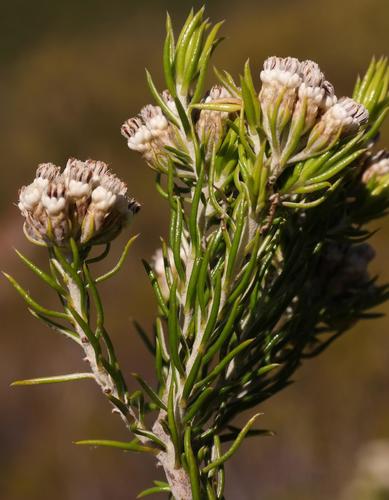
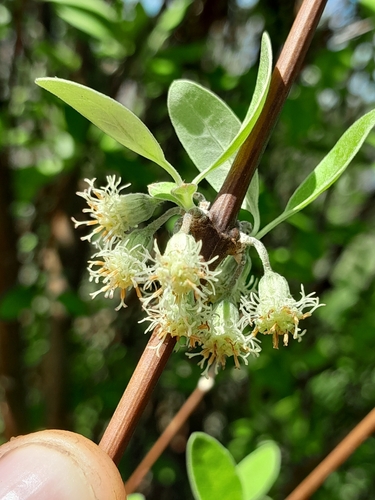
Olearia hectorii Hook.fil. is a deciduous shrub or small tree that grows up to 10 metres (33 feet) tall. It has reddish stems, furrowed bark, and oppositely arranged clusters of 2 to 4 gray-green leaves. The leaves measure 20–50 mm long by 5–20 mm wide, and their undersides are covered in a silvery indumentum. Like most other members of the Asteraceae family, its tiny flowers grow in dense clusters called pseudanthia. These clusters form on short, hairy stems that emerge near leaf axils. The florets are pale yellow, and enclosed by pale green, densely hairy phyllaries. Its seeds are cypselae, structurally similar to dandelion seeds: each consists of a 1–2 mm achene attached to a 3–5 mm feathery pappus. This species is threatened by habitat degradation. It requires open habitat to germinate, and this open habitat type is threatened by introduced plants and grazing animals. Olearia hectorii is a host plant for numerous endemic moth species; it is known to support at least 23 moth species, and at least 12 of these species rely exclusively on this plant as a host. These moths are likely to play an important role in the pollination of Olearia hectorii. Moth species dependent on this plant include the nationally critically endangered Stathmopoda campylocha and the nationally endangered Stathmopoda albimaculata.