About Olearia arborescens (G.Forst.) Cockayne & Laing
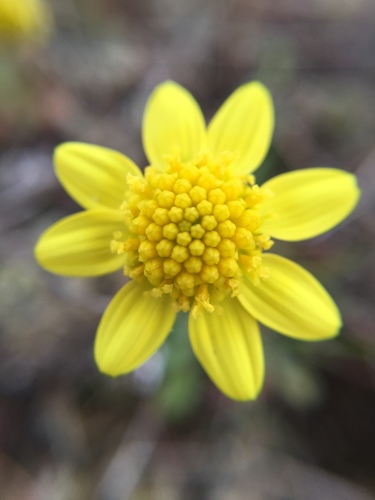
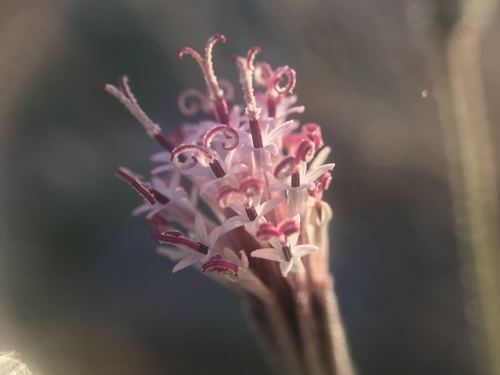
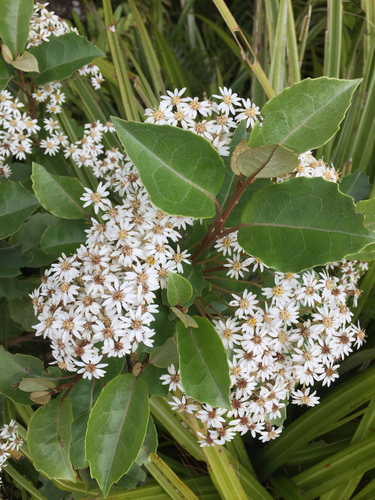
Common Tree Daisy, scientifically named Olearia arborescens (G.Forst.) Cockayne & Laing, is a woody plant with a bushy or tree-like growth form. Its leaves are dark green with a light greyish underside and a glossy surface, typically growing 4 to 8 cm long, borne on 2 cm long petioles. Leaves have pinnate venation, smooth margins, and are arranged simply along stems. Mature plants usually reach around 4 metres in height. When flowering, the plant produces nearly spherical clusters that each hold 15 to 20 florets. Each cluster consists of white florets surrounding small fluffy yellow heads. After flowering, the plant develops fluffy, winged seeds dispersed by wind. The inner pappus of the flower has hairs that grow up to 5 mm long. Olearia arborescens is an endemic species of New Zealand, meaning it is found nowhere else in the world, though the wider genus Olearia is not restricted to New Zealand. Within New Zealand, it grows across both the North and South Islands, most commonly in the Southern Alps and central Otago. It does not tend to grow in the warmer climates of the northern North Island. This species inhabits lowland areas or alpine shrubland, predominantly mountainous regions such as the Southern Alps, and lowland areas such as beech forests. Its habitats commonly have extreme climates, and it often experiences strong competition from other plants including grasses and other shrubs. Alpine habitats where it grows are isolated areas of flora and fauna diversity, and pose distinct challenges to inhabitants: high wind levels, short growing seasons, and low sunlight levels are all regular parts of this species’ life cycle when growing in alpine locations. In lowland beech forests, the main challenges for Common Tree Daisy are reduced sunlight from shading by larger plants, and variable water availability. A Department of Conservation survey found Olearia arborescens growing in riparian areas beside creeks within lowland beech forests. Overall, the species tolerates low-lying areas but prefers alpine locations. Olearia arborescens flowers from October to January, which corresponds to mid-spring through mid-summer in the Southern Hemisphere. Fruits develop from the flowers between December and March. Seeds are winged, a trait that supports wind dispersal. Results from a Landcare Research trial of planted Olearia seedlings indicate that seeds germinate around October. Seeds can persist in the soil for 9 to 12 months, depending on environmental conditions. This species has a very low germination rate, which may explain why it is recorded as relatively uncommon across New Zealand.