About Olearia algida N.A.Wakef.
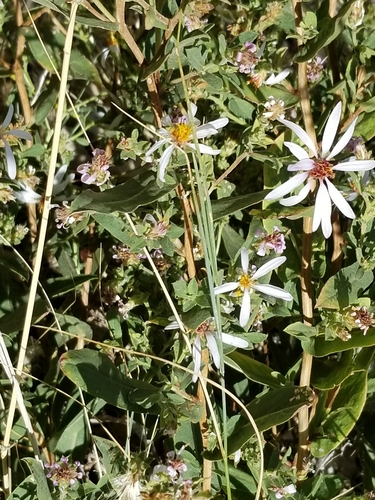
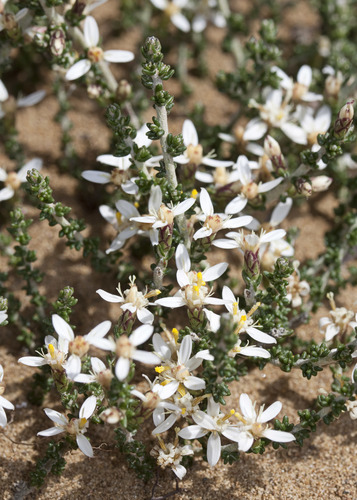
Olearia algida N.A.Wakef. is a bushy shrub that typically grows 0.7 to 1 meter (2 feet 4 inches to 3 feet 3 inches) tall. Its young branchlets are covered in cottony hairs. The leaves are alternately arranged, crowded, and shaped elliptic to narrow egg-shaped with the narrower end at the base. Each leaf measures 1 to 3 millimeters (0.039 to 0.118 inches) long and 0.5 to 1 millimeter (0.020 to 0.039 inches) wide, with edges rolled under. The upper leaf surface is glabrous, while the lower surface is covered in woolly hairs. Daisy-like capitula form singly at the ends of short side-branches, and measure 7 to 12 millimeters (0.28 to 0.47 inches) in diameter. Each capitulum holds 2 to 6 white petal-like ray florets, with ligules 2.5 to 5.5 millimeters (0.098 to 0.217 inches) long, surrounding 2 to 6 yellow disc florets. Flowering occurs mainly from October to February. The cypselae are around 1.5 millimeters (0.059 inches) long, with bristles around 3 millimeters (0.12 inches) long. This species, commonly called alpine daisy-bush, grows in heath, shrubland and grassland near swampy areas in alpine and subalpine regions. Its natural range extends south from Mount Gingera in the Australian Capital Territory, through southern New South Wales to eastern Victoria and Tasmania, and it is also cultivated in New Zealand.