About Ognorhynchus icterotis (Massena & Souance, 1854)
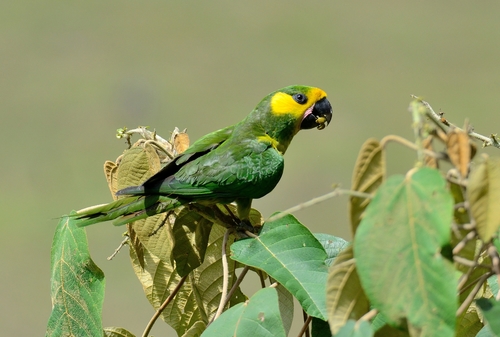
The yellow-eared parrot (Ognorhynchus icterotis) is a relatively large, long-tailed parrot, with an average length of 42 cm (17 in) and a weight of about 285 g (10.1 oz). Its body is mostly green, with paler, more lime green underparts than upperparts. Its heavy beak and the ring of bare skin around its eyes are black. Its common name comes from the yellow feather patch that extends from its forehead down to its cheeks and ear-coverts. Its calls sound similar to the calls of geese. The yellow-eared parrot lives and nests among wax palms in a small number of areas in the Western and Central cordilleras of Colombia, which are northern subranges of the Andes. It inhabits cloud forests located 1800–3000 meters above sea level, and nests in the hollow trunks of wax palms, usually 25–30 meters above the forest floor. It also occurred in very restricted local areas of northern Ecuador. This species' population has been greatly reduced; a 1999 Colombian census recorded only 81 individuals. Population declines have been driven by hunting and habitat destruction, particularly the harvesting of wax palm, which was traditionally cut down annually for use in Palm Sunday celebrations. There has been no confirmed record of this parrot in Ecuador since the mid-1990s. The wild population holds 212 mature individuals, and the total estimated wild population across all age classes is 1,408 individuals. The species is also found in Riosucio, Caldas, Colombia. The yellow-eared parrot has suffered heavily from habitat fragmentation and habitat loss. In Colombia specifically, over 90-93% of montane forests have been cleared for agricultural use or human settlement. Decline has been worsened even when large areas of historical habitat remain, as the remaining current habitat is the most impacted. The yellow-eared parrot depends heavily on the Quindio wax palm (Ceroxylon quindiuense), a palm species native to the humid montane Andean forests of Colombia. The parrot uses this palm for roosting, nesting, and feeding on its fruits, nesting 25–30 meters above the forest floor inside the palm's trunk. The Quindio wax palm itself has become highly threatened because its fronds are used to adorn Palm Sunday processions. Additional threats to the yellow-eared parrot include residential and commercial development (such as housing and urban areas), plus logging and wood harvesting. The yellow-eared parrot is hunted for food at local and national levels. Internationally, capture for use as a pet or display animal has also contributed to the species' decline. Previous hunting for food, especially in Ecuador, is the reason very few to no individuals of this species are found in Ecuador today.