About Oenothera villosa Thunb.
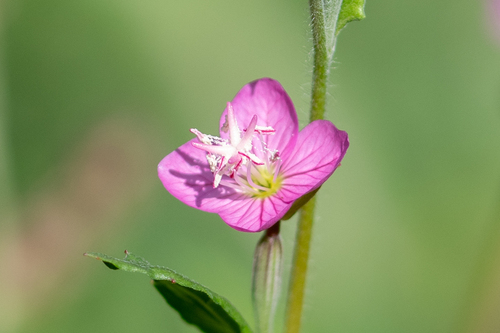
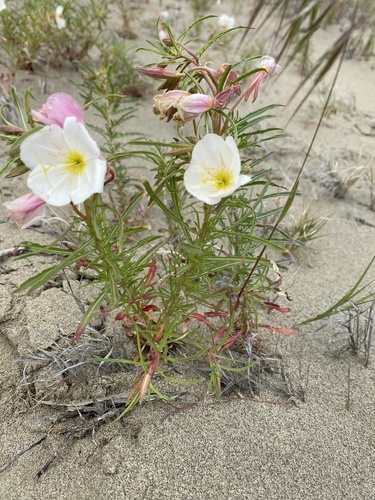
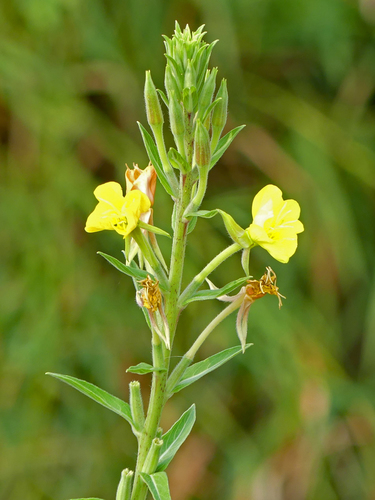
Oenothera villosa Thunb. is a strigillose, red-stemmed biennial dicotyledon with a taproot. Strigillose means the plant is covered in erect trichome hairs that stick straight out from the stem, rather than being curled. This plant typically has green lanceolate, or sword-shaped, leaves with sinuate lobes that follow a wavy bending pattern. Leaf margins are most often fully denticulate, meaning fully edged with small teeth, or partially entire with smooth edges and partially denticulate. Rarely, leaves can have moderate dentate margins with somewhat larger teeth. Leaf surfaces on both the front and back are mildly to moderately covered in hairs, and leaves sometimes have a waxy coating along their edges. Leaves measure 2.5 to 10 cm (1 to 4 inches) long. Its herbaceous branches are also covered in these fine hairs. The campanulate, or bell-shaped, yellow flowers are arranged in a terminal spike that grows from the crown of the plant. The outer side of the flowers have red stripes, while the inside of the flowers is entirely yellow. Open flower clusters have an obtuse apex. Flowers measure 1.5 to 3.5 cm (0.5 to 1 inch) wide, and bloom from June through September in the United States. The plant produces cylindrical fruit capsules, or seed pods, that are thick at the base, 1.3 to 3 cm (0.5 to 1.3 inches) long, and do not grow longer than the spacing between the plant's leaf nodes. The seeds are very small, only 1.3 to 1.5 mm long, and are self-pollinating. Oenothera villosa typically reaches 3 to 5 feet in height, though some sources note it can grow up to 6 to 7 feet tall. It grows in wastelands, disturbed areas, and alongside roads, and can be found in almost all U.S. states, excluding a small number of states with extreme cold, or extreme hot and humid conditions. Some sources for this description draw from information on Oenothera biennis, a closely related plant; Oenothera villosa is sometimes treated as a subspecies of Oenothera biennis, differing mainly in stem trichomes, while most height and flower characteristics are very similar between the two. Oenothera villosa is less commonly used than many garden or culinary plants, but it has a few noted uses. It is sometimes planted in home gardens to attract butterflies (lepidopterans), other pollinating insects, and birds. Its seeds contain evening primrose oil (EPO), which holds the omega fatty acid Gamma Linolenic Acid (GLA) shared by a number of closely related evening primrose species. This oil is used as an active ingredient in some therapeutic medicines, applied to treat conditions that may respond to omega fatty acids, though the accuracy and efficacy of the oil for relieving these conditions was still debated among medical professionals as of 2007. Common uses for EPO include applications in assistive reproductive health technologies and medicine, where it is used to treat reproductive conditions including female breast inflammation, euglycemic diabetes, general inflammation, menopause disorders, and menstrual disorders. Some women use medications containing this oil before birth to support reproductive health, and have reported no harmful effects from use, though its benefits for these conditions are not 100 percent proven.