About Oenothera fruticosa L.
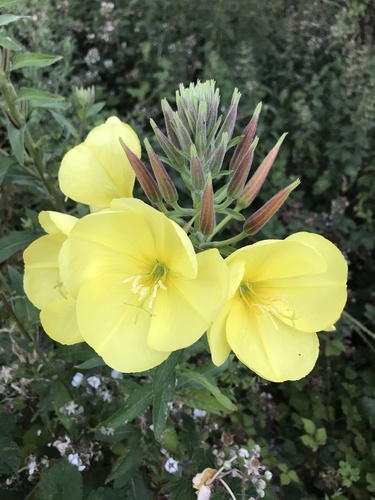
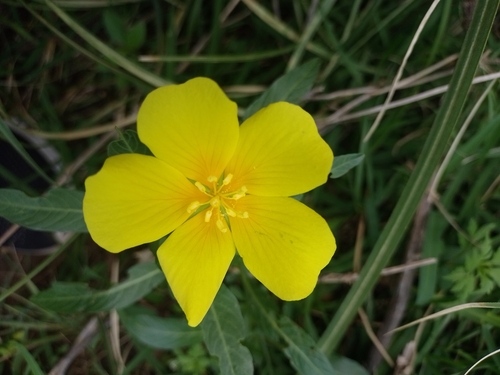
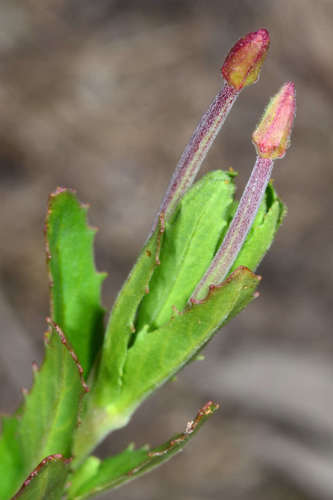
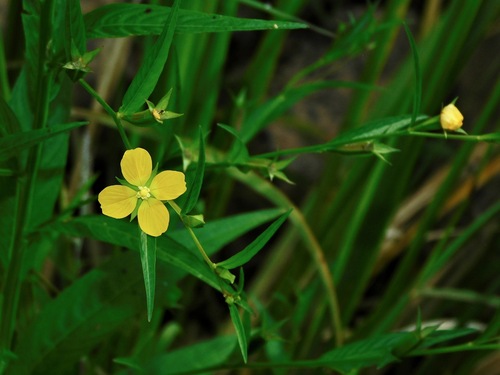
Oenothera fruticosa L., also called common sundrop, narrow-leaved sundrop, or narrow-leaf evening primrose, is a perennial wildflower species of evening primrose. It grows to a height between 16 and 36 inches. Its leaves are alternate, lance-shaped, 2 to 3 inches long, and covered in fine short hairs. Its stem is straight, also covered in fine short hairs, and ranges in color from red to green. Its flowers have rounded petals that measure 1 to 2 inches long. This species flowers from spring to early summer.
The seeds of Oenothera fruticosa are roughly 1 to 3 mm long, arranged in two rows inside each locule, and have a persistent one-cell-layer-thick endotegmen. The seeds are club-shaped, tapering near the attachment to the stem. The seed capsule of this species is approximately 1 inch wide, and is visible from May through November. Oenothera fruticosa can be propagated by tip cuttings, which is best done on fully grown adult plants either at the start of the growing season in early spring, or late in the growing season in fall. Seeds must be planted in either spring or fall, and require germination temperatures around 70 degrees Fahrenheit.
This species has a wide distribution across the United States, ranging from the eastern seaboard between New York and Florida westward to Oklahoma. Throughout its range, it prefers lower elevation sites. Within North Carolina, which falls inside its range, the species is widespread across the state, absent only from mountainous regions. Oenothera fruticosa grows best in full sun locations with well-drained, mostly acidic sandy soils. It is relatively resilient to drought, shade, extreme heat, and a range of soil pH levels. In its native range, it is most often found in grassy clearings, meadows, and alongside roadways.
The Cherokee people parboil the leaves of this plant, rinse them, and cook them in hot grease to eat as a potherb. Historically, multiple Native American tribes including the Iroquois, Cherokee, and Ojibwa used Oenothera fruticosa to treat a variety of ailments; common uses across tribes included addressing stomach issues, supporting weight loss, treating bruising, and treating hemorrhoids. It is currently unknown whether this species is medically effective for these uses, and it has been included in research focused on breast cancer. Today, Oenothera fruticosa is primarily grown as a garden plant. In landscaping, it is used as a barrier or border plant. It is also added to pollinator gardens, rock gardens, cottage gardens, and native gardens, valued for its attractive yellow petals and its ability to attract pollinators. This species is a host plant for pearly wood nymphs, momphid moths, and primrose moths. Its seeds are eaten by birds, including the eastern goldfinch and mourning dove.