About Oenothera cespitosa Nutt.
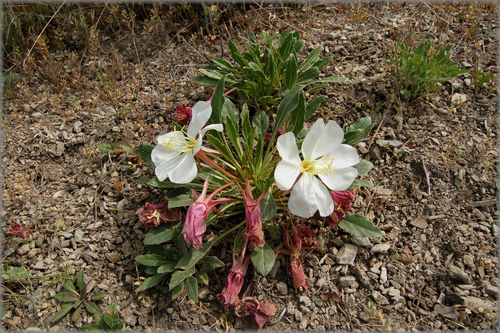
Oenothera cespitosa, commonly called tufted evening primrose, is a low-growing herbaceous plant that grows from a large taproot. Plants may either lack stems entirely, or produce stems that can grow up to 40 centimeters (16 inches) long. When stems are present, they are quite variable: they may be branched near the base or unbranched, are usually covered in fine glandular hairs, but may occasionally be hairless. New shoots sometimes grow from the plant's slender, spreading side roots, and while the rest of the plant is herbaceous, its caudex is woody. The leaves grow in a basal rosette. Leaves are sometimes hairless, but more often they range from puberulent (covered in small fine hairs) to villous-hirsute (covered in long, fine to coarse-textured hairs), and they tend to be especially hairy along their edges. Leaves measure between 1.7 and 36 centimeters long, usually shorter than 26 cm, and 0.3 to 6.5 cm wide, most commonly 0.5 to 4.5 cm wide. Their overall shape is normally oblanceolate, rhombic, or spatulate, but is highly variable. Leaf edges are irregularly toothed, wavy, or lobed, and leaf tips may be narrowly pointed or rounded.
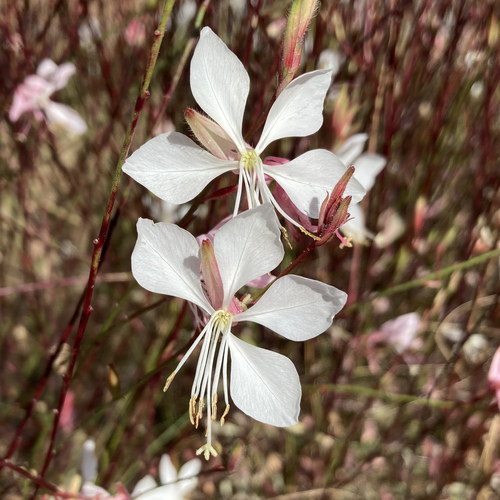
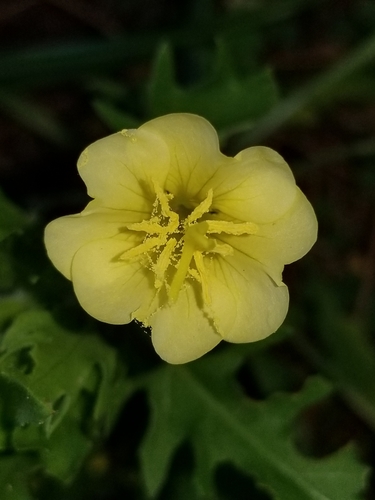
The four-petaled white flowers open in the afternoon to evening, stay open all night, and wilt when it gets hot the next day. As petals fade, they darken to turn light rose to dark rose purple. Pressed specimens of the flowers are generally darker than flowers on living plants. Open flowers produce a strong, sweet floral scent with a faint additional rubber-like odor. Each petal is 1.6 to 6 centimeters (0.6 to 2.4 in) long, most often 2 to 5 cm (0.8 to 2.0 in). A notch at the center of the petal tip can make the shape obcordate (heart-shaped, with the point attaching to the floral tube), or petals can be obovate (teardrop-shaped). The flower has a long tube extending back to its attachment point on the plant. Each flower bud develops individually in a separate leaf axil, the crevice where a leaf base attaches to the plant. Closed buds are covered by four sepals that are 1.5 to 5.5 cm (0.6 to 2.2 in) long, which curve backwards separately when the flower opens. During the bloom season, each stem may produce one to six flowers per evening. Depending on elevation, the blooming season can start as early as April and end as late as August.
Tufted evening primrose is native to western North America, ranging from southern Canada to northern Mexico. In Canada, it only grows in three provinces: Alberta, Manitoba, and Saskatchewan. In Mexico, it occurs in four states: Baja California, Baja California Sur, Chihuahua, and Sonora. Most of its range falls within the western United States. There, it grows in interior Washington and Oregon, eastward through Idaho and Montana to cover half of North Dakota and South Dakota. To the south, it only grows in four far western counties of Nebraska, but grows in almost all of Wyoming, Colorado, and New Mexico. The United States Natural Resources Conservation Service lists it as present in Texas, but does not provide a specific location for populations there. It is also native to all of Arizona, Utah, and Nevada, and only grows in a few dry areas of northeastern California and southern California deserts.
This species grows in a wide variety of habitats, including grasslands, desert scrub, piñon–juniper woodlands, Arizona chaparral, and mountain conifer forests. It is rarely found growing above timberline. It is particularly known to grow in disturbed habitats such as alongside roadways, and also grows on talus slopes and in sandy areas. It usually occurs in dry habitats, and most often grows at elevations of 800 to 3,370 meters (2,620 to 11,060 ft), though it can rarely grow as low as 450 m (1,480 ft).
The plant is a larval host for the white-lined sphinx moth (Hyles lineata). The very small moth Mompha definitella lays eggs in the flower buds, and its larvae create galls where they feed. Oenothera cespitosa is primarily pollinated by large hawkmoths that hover over the flowers. The white-lined sphinx moth is the most common hawkmoth visitor. Other hawkmoth species from the genera Sphinx or Manduca also visit the flowers; specifically noted visitors include the Vashti sphinx (Sphinx vashti), great ash sphinx (Sphinx chersis), and five-spotted hawkmoth (Manduca quinquemaculata). Three unidentified moth species from the family Noctuidae also sometimes pollinate the flowers. Bees such as Lasioglossum aberrans and Lasioglossum lusoria visit the flowers during the day, but Lasioglossum bees are primarily pollen thieves for tufted evening-primrose. Large bees can act as pollinators in some cases; for example, three bee species (Andrena anograe, Anthophora affabilis, and Anthophora dammersi) have been observed acting as either pollen thieves or pollinators depending on conditions. At least one other species in Anthophora and another in Agapostemon also behave this way. A subspecies of the mountain carpenter bee (Xylocopa tabaniformis androleuca) will sometimes rob nectar and sometimes pollinate the plant. One species of bumblebee (Bombus) and one species in Tetraloniella are conditional pollinators that do not steal pollen.
In cultivation, tufted evening-primroses are grown in rock gardens, moon gardens, and native plant gardens. They are valued for attracting hawk moths, their pleasant scent, and their long six-week blooming season that falls in early to late summer. The plants require good drainage to grow well.