About Oenocarpus bataua Mart.
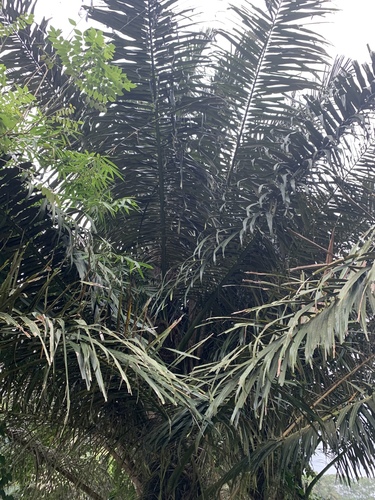
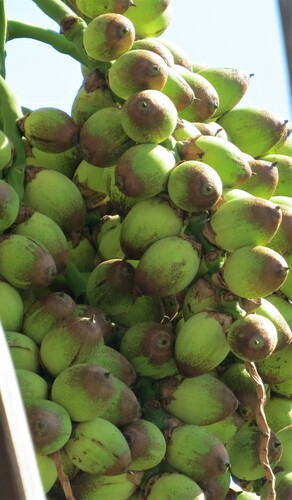
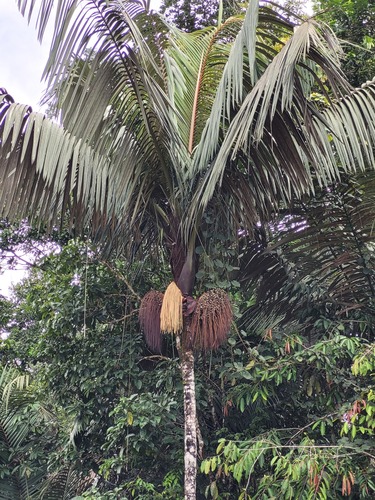
Oenocarpus bataua Mart. is a palm species with a solitary, erect, smooth stem marked with ring-shaped patterns. The stem measures 10–25 m (33–82 ft) in height and 2–3 dm (8–12 in) in diameter. This species produces 10–16 terminal leaves, with a 10–50 cm (3.9–19.7 in) petiole and a 3–7 m (9.8–23.0 ft) long rachis. Each leaf holds approximately 100 leaflets per side, arranged in the same plane; individual leaflets can reach up to 2 m (6 ft 7 in) long and 15 cm broad. Its inflorescence grows 1–2 m (3 ft 3 in – 6 ft 7 in) long, and bears around 300 rachillae that reach up to 1.3 m (4 ft 3 in) in length. The flowers are yellow, with 2 mm (0.079 in) long sepals and 7 mm (0.28 in) long petals. This species is native to the tropical rainforests of South America, and is abundant in wet habitats at elevations below 1,000 m (3,300 ft). Its range extends from Panama and Trinidad into the Amazon basin, covering Colombia, Venezuela, the Guianas, Brazil, Bolivia, Ecuador, and Peru. Two varieties are currently recognized: Oenocarpus bataua var. bataua, which occurs in Panama and South America, and Oenocarpus bataua var. oligocarpus (Griseb. & H.Wendl.) A.J.Hend., which is found in Trinidad, Venezuela, and the Guianas. In Western Amazonia, O. bataua ranks among the top three palm species for both frequency and abundance. It reaches its highest population densities in soils with low to intermediate nutrient concentrations. In Colombia, it most commonly occurs in organic-rich sandy soils that are prone to flooding; this may be due to the low number of competing species in these habitats. It can grow very successfully on unflooded soils, as demonstrated by high-density stands found in pastures of the Colombian Chocó. However, it is rarely found on wild terra firme, because competition from other plant species means it rarely receives the high light levels it needs to produce fruit. Commonly called patawa, the fruits of this species are used in cosmetics, food products, and pharmaceutical products. Traditionally, indigenous peoples collect the fruit, ripen it in tepid water, and use it to prepare drinks and extract fruit oil. The drupes of O. bataua contain 8–10% oil by proportion. The rachis of the leaves has been used to make arrows, while the leaves are used to weave baskets and build temporary shelters. Additionally, Rhynchophorus palmarum larvae are harvested from this palm.