About Oenanthe pleschanka (Lepechin, 1770)
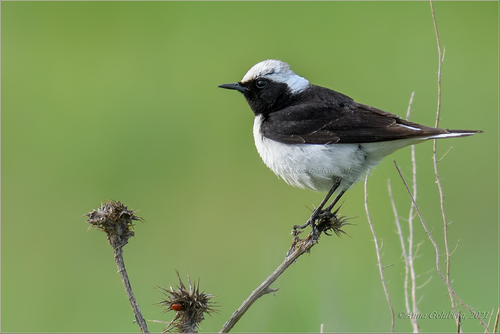
This species, the pied wheatear, has the scientific name Oenanthe pleschanka (Lepechin, 1770). For adult males, the crown, nape, and neck are pale brown, with individual feathers having pale tips and white bases. The mantle and scapulars are black, with buff-colored feather tips. The back, rump, and upper tail-coverts are creamy-white. The central pair of tail feathers are black with white bases, while the rest are white with black tips; the outer pair has noticeably more black than the other tail feathers. A narrow buff-colored line runs from the base of the beak to past the eye. The lores, ear coverts, chin, throat, and upper breast are black. The remainder of the breast is buff, the belly is creamy-buff, and the underwing coverts and axillaries are black with white tips. Wing feathers are black with creamy-buff tips and edging. This species moults in late summer. By the following year, feather edges become abraded, so the crown and nape turn white, while the mantle, scapulars, and wings become solid black. The beak, legs, and feet are black, and the eyes are dark brown. Adult males reach a total length of approximately 5.75 inches, or 146 mm.
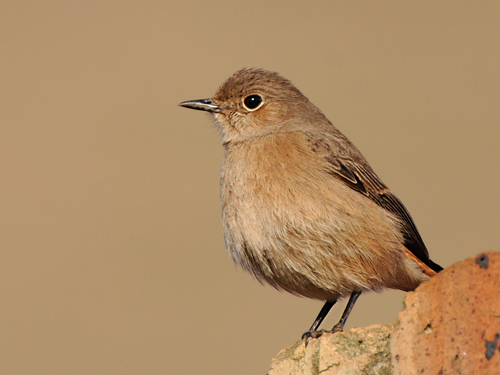
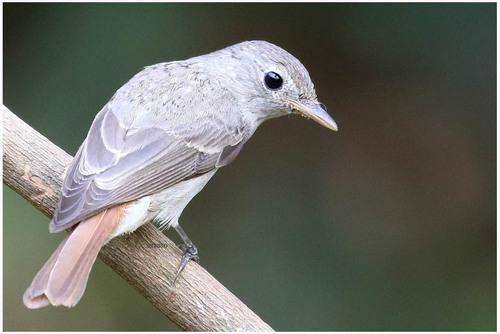
Adult females are similar in overall appearance to males, but their mantle and scapulars are brown with buff tips instead of black. Their tail feathers are brown and white, and their wing feathers are brown with buff tips. Abrasion also wears away these feather tips over time, leaving females with a more uniform mix of brown and white plumage, and creamy buff underparts. Females are slightly smaller than males.
Juveniles are similar to females, but the feathers of their brown upperparts have pale centres near the tips, which gives the bird a distinctly speckled appearance.
The common call of the pied wheatear is a harsh zack zack. The male’s song is low-pitched and musical; it is performed in early summer and again in August. The song is a continuous stream of variable, imitative notes, which can be lark-like or whistling. Males sing from a perch on a rock or other high spot, or while flying through the air.
The pied wheatear is native to Southeast Europe and Western Asia. Its breeding range stretches from Romania and Bulgaria east to Siberia, the Altai Mountains, and Mongolia, and south to the Caucasus, Transcaspia, Turkestan, Iran, and Afghanistan. It can be found at altitudes up to 2,000 metres (6,600 ft) in the Altai, and up to 3,000 metres (9,800 ft) in the Tien Shan. It is a migratory species; it travels to Northeast Africa for the winter, passing through Southwest Asia along its migration route. During the breeding season, it inhabits rough open country, steppes with sparse vegetation, stony slopes, and hilly areas. In its winter range, it occupies similar habitats with rock, scree, and plains with thorny scrub. It will sometimes also visit grassy areas and gardens. It has been recorded as a vagrant in Italy, Heligoland, and Scotland.