About Oenanthe pileata (Gmelin, 1789)
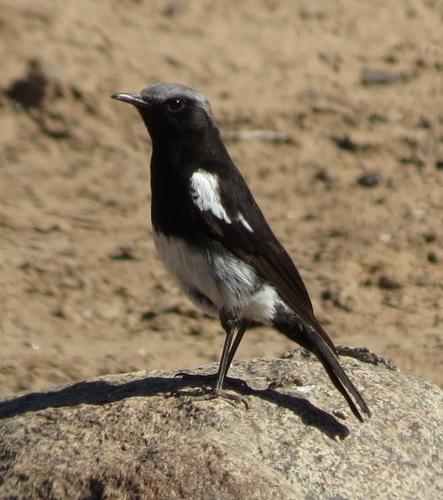
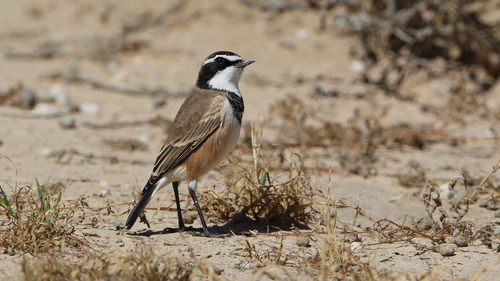
Oenanthe pileata, commonly called the capped wheatear, measures 17–18 cm in length and weighs approximately 32 grams. It has black legs and a pointed black bill, and this common species has a striking, easily identifiable appearance. Adult capped wheatears have black coloring on the cap, cheeks, and breast band, with a white eye stripe and white throat. The remaining underparts are white, with light buff coloring on the flanks and lower belly. Like other wheatears, it has a distinctive tail pattern: black feathers on the base and centre of the tail form an inverted T shape against an otherwise white rump. Juveniles have brown coloring on the cap and cheeks, and their breast band is weak and diffuse. Even so, the presence of a breast band, larger body size, and white coloring at the base of the outer tail feathers distinguish this species from the migrant northern wheatear, which is rare across most of the capped wheatear’s range. Capped wheatears inhabit open, dry, sandy and stony environments, as well as short grassland scattered with a few bushes and termite mounds across Africa. Its range extends from Kenya and Angola southward to the Cape. It is mostly non-migratory, but does make seasonal movements.