About Oenanthe picata (Blyth, 1847)
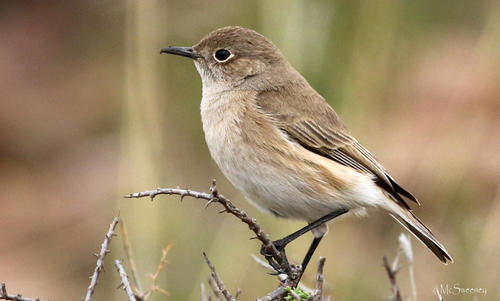
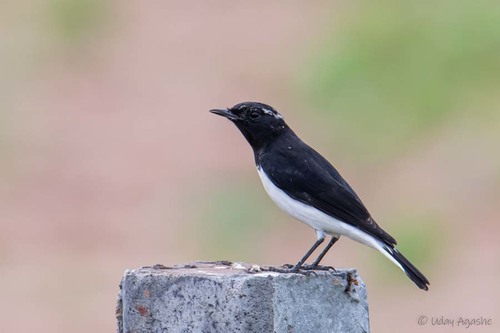
Oenanthe picata, commonly known as the variable wheatear, is a bird that occurs in arid and semi-arid regions. It is locally abundant in barren rocky areas, sand dunes with scrub vegetation, cultivated land, ravines, areas outside villages, and areas around nomadic encampments. This species is polymorphic, with three distinct color morphs. The first morph is the black-bellied phase, also called 'opistholeuca'. In adult males of this phase, the entire body is jet black, with the exception of the rump, undertail-coverts, and the base and sides of the tail, which are white; the central rectrices and the terminal band of the tail are black. In females of this phase, the black body regions of the male are replaced by sooty black. The second morph is the white-bellied phase, also called 'picata'. Adult males of this morph match the black-bellied phase, except that their belly is white. Females are similar to males of this morph, but the black body regions are replaced by grayish brown, and the belly is more buffish in tone. The third morph is the white-crowned phase, also called 'capistrata'. Adult males of this morph resemble white-bellied phase males, having a white belly and black throat, but additionally have a white crown and nape. Females are similar to males of this morph, but the black body regions and crown are earthy brown, and the belly is more buffish in tone. The geographical dominance of the three female morph types does not exactly match the dominance of the three male color phases, though there is some corresponding separation between the morphs in their wintering grounds. This species breeds from northeast and southeast Iran and Turkmenistan eastward to western Tien Shan, the Pamirs, and northern and western Pakistan. It is non-breeding in southwest Asia. In the winter season, it is common and widely distributed in Pakistan and northwestern India, ranging southeast to Delhi, central Madhya Pradesh, and northern Maharashtra (Khandesh). The species arrives on its breeding grounds in March in Baluchistan, or mid April in Chitral, and remains on breeding grounds until September. It may be present in winter quarters from the beginning of August in Karachi district until the end of March. In winter, it frequents stony semi-desert, desert with sparsely scrubbed sand dunes, cultivation, ravines, the outskirts of villages, nomadic encampments, and cattle corrals, among other sites. It usually occurs from near sea level to around 1200 m, but has also been observed at 2700 m in deep snow.