About Oenanthe lachenalii C.C.Gmel.
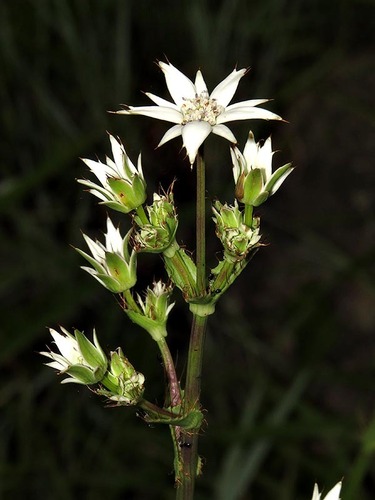
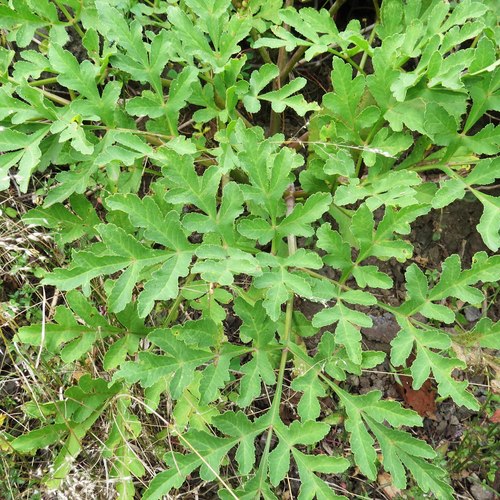
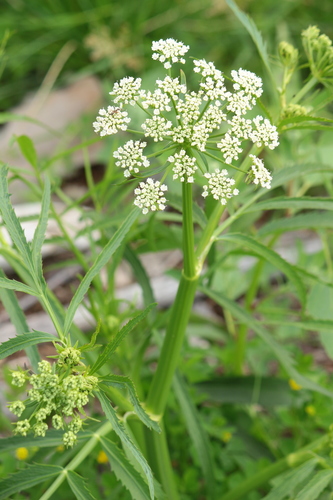
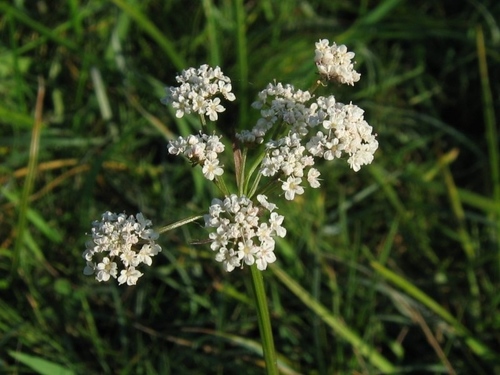
Parsley water-dropwort (scientific name Oenanthe lachenalii C.C.Gmel.) is a hairless perennial herb that grows up to 100 cm tall. Its stems are cylindrical, striated, and 0.4 cm in diameter; they are solid when young, and may become hollow as the plant ages. The roots are somewhat cylindrical and swollen, but do not form the distinct tubers found in some other species of this genus. Upper leaves are once to twice pinnate, with simple linear leaflets that reach up to 5 cm long. Lower leaves are twice pinnate, with wider, flat leaflets that more closely resemble leaflets from other umbellifers. Leaf stalks are shorter than the leaf blade, sheath the stem at their base, and give off a celery scent. In northern Europe, this species flowers between June and September. It produces umbels made of 5 to 9 smaller umbellules, each 1-2 cm in diameter and holding many white flowers. The main umbel has roughly 5 awl-shaped bracts, and each individual umbellule has 5-7 small bracteoles at its base. Plants are monoecious: all umbels contain both hermaphroditic and male flowers, but the share of hermaphroditic flowers drops as the flowering season progresses. Each flower has 5 unequal petals (the larger outer petals are slightly bigger than the rest), 5 stamens, and 2 prominent styles that grow from a swollen base called a stylopodium on top of the ovary. After flowering, the flower stalks do not expand, unlike in some other water-dropwort species, and the umbels do not become flat-topped.
Parsley water-dropwort is very similar to narrow-leaved water-dropwort, and the two species are often confused. In most cases they can be easily distinguished: parsley water-dropwort usually has bracts on its main umbels, its flower rays do not thicken after flowering, and its umblets do not become flat-topped when developing fruit. However, some parsley water-dropwort plants lack bracts, making identification difficult when the plant is in flower. Early in the year, parsley water-dropwort typically has broader, parsley-like leaflets on its lower leaves. The most reliable confirmation of identification comes from mature fruit: parsley water-dropwort fruit is winged, while narrow-leaved water-dropwort fruit is only ridged.
The global natural range of parsley water-dropwort covers Western Europe, extending north to southern Scandinavia, east to Poland, south to Greece and the African coast. It has not been recorded as an introduced species outside its native range. In Britain, it is classified as Least Concern, meaning it is not rare and not declining at an unusually high rate, though it still faces threats especially in inland areas. In England, its population decreased by 24% between 1969 and 1999; in the English county of Kent, this decline reached 41%, even though the species remains non-scarce there. Causes of decline include wetland drainage and agricultural intensification, and it is considered an axiophyte in every British county. In France, it is widespread and classified as Least Concern, with generally stable overall populations. However, it is rare and threatened in some inland regions: it is listed as Critically Endangered (CR) in Alsace, Endangered (EN) in Île-de-France, and thought to be locally extirpated (extinct) in Auvergne.
Parsley water-dropwort is a wetland plant. It grows primarily in slightly brackish grassland near the coast, and also occurs in freshwater inland marshes, especially in France and Spain. In Britain, it grows across a range of habitats: from the upper section of salt marshes, through brackish dykes, to inland base-rich fen-meadows. It is fairly common along the coasts of Britain and Ireland, except in northern and eastern Scotland. Its Ellenberg values in Britain are L = 8, F = 8, R = 8, N = 5, and S = 3. Studies in the Aiguamolls de l'Empordà, Spain, recorded it growing across multiple habitat types: tall fescue/meadow barley meadows with wild celery, saltmarsh rush and narrow-leaved bird's-foot trefoil; wetter water finger-grass/divided sedge grassland; and brackish marsh with annual beard-grass, sea aster and Somerset rush.
While it can occur as a component of hay meadows, parsley water-dropwort is considered poisonous to livestock. It is less toxic than hemlock water-dropwort, but no part of the plant is edible for humans, and it has no known commercial uses.