About Oenanthe cypriaca (Homeyer, 1884)
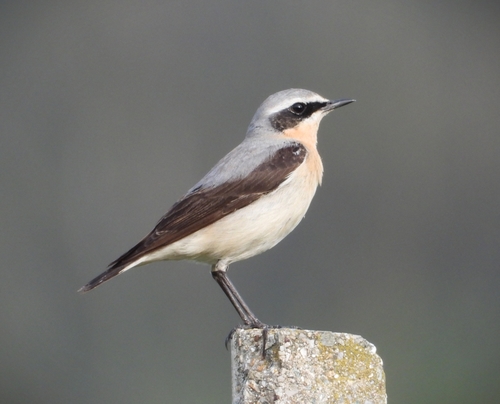
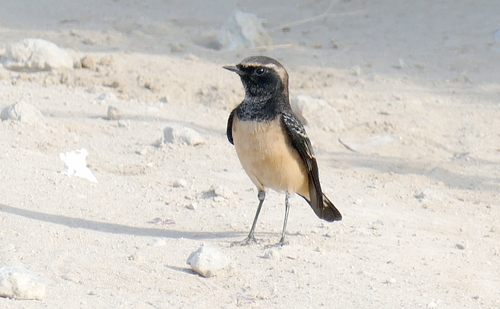
The Cyprus wheatear, also called the Cyprus pied wheatear, has the scientific name Oenanthe cypriaca. It is a small passerine bird that measures 14–15 cm in length. Formerly classified as part of the thrush family Turdidae, it is now most widely considered a member of the Old World flycatcher family Muscicapidae. It was previously treated as a subspecies, or race, of the pied wheatear, but in 1982 Sluys and van den Berg argued that this form deserved full species status, based on differences in biometrics, especially song, and the lack of sexual plumage dimorphism in O. cypriaca. This is a migratory, insect-eating species that breeds only in Cyprus, and winters in southern Sudan and Ethiopia. It has been recorded as a vagrant on Heligoland, Germany. This species closely resembles the pied wheatear, though it has slightly more black plumage on its tail, back, and head. The sexes are similar in appearance, a fact first documented by Christensen in 1974. A 2010 study found that the Cyprus wheatear differs from the pied wheatear in fourteen external morphometric characters. Its song is distinctive, very different from the song of the pied wheatear, and resembles an insect. The song consists of a series of high-pitched buzzing bursts. Song perches used by this species are high for a wheatear, typically 5 to 10 metres above ground. Unlike other wheatears, it often breeds in woodland habitats; in 1990 Oliver suggested it occupies the ecological niche used elsewhere in the Western Palearctic by the common redstart. It is the most arboreal wheatear species in the Western Palearctic, and often uses aerial sallying and perch-pounce feeding tactics. Recent research suggests there is ecological differentiation between the Cyprus wheatear and migrating northern wheatears (O. oenanthe) and black-eared wheatears (O. hispanica melanoleuca). According to Randler et al. (2009), the Cyprus wheatear uses more aerial sallying, occupies more forested habitats, and requires a minimum amount of open or bare ground as well as a minimum of tall bush or tree vegetation.