About Oenanthe crocata L.
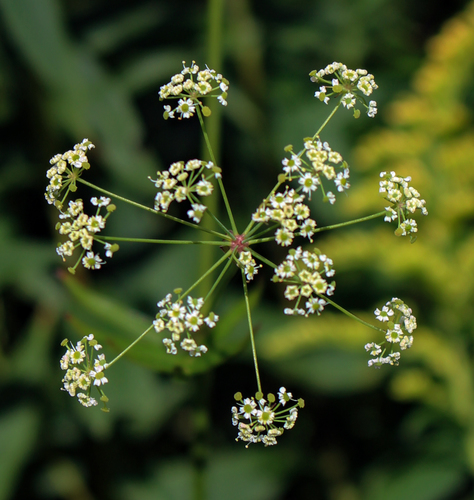
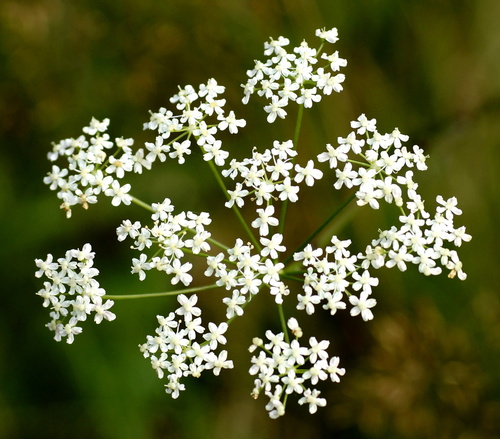
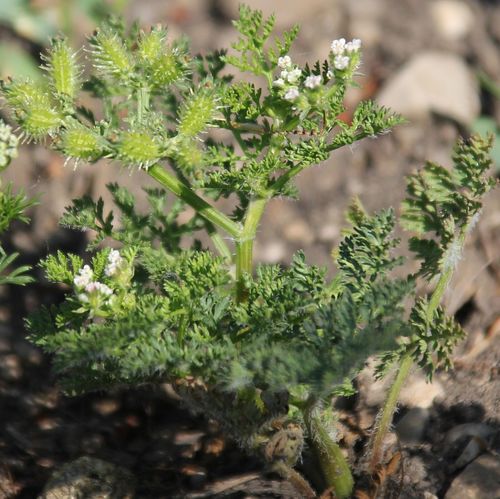
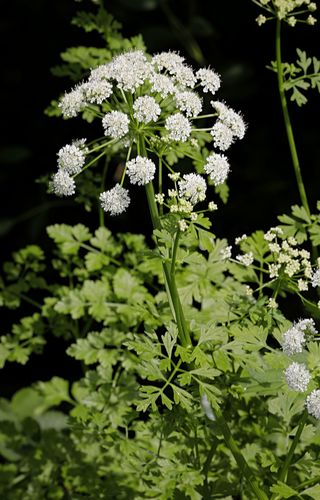
Oenanthe crocata, commonly called hemlock water-dropwort, is a robust, hairless perennial herb that grows up to 150 cm tall. It has hollow, cylindrical, grooved stems that reach 3.5 cm across, and stems are often branched. The upper section of its root system holds five or more obovoid, pale yellow, fleshy tubers up to 6 cm long; when cut, these tubers release a yellowish oily fluid that stains skin. Lower leaves are 3–4 times pinnate, triangular in shape, with oval toothed leaflets 10–20 mm long that taper to a cuneate base at the stalk. Upper leaves are 1–2 times pinnate, with narrower lobes and a shorter leaf stalk (petiole). All leaves are arranged spirally, and their petioles form a slight sheath around the stem. The leaves have a characteristic deceptive smell similar to parsley or celery. Like other species in the Oenanthe genus, hemlock water-dropwort produces flower clusters called compound umbels. Each compound umbel has 12–40 smooth 3–8 cm long rays (stalks) that hold smaller umbellules. These rays are shorter than the main peduncle (stalk) below them, and do not thicken after flowering. About five linear to trifid-shaped bracts grow at the base of the rays. Umbels are either terminal (growing at the top of the stem) or lateral (growing in leaf axils). Umbellules are 5–10 cm in diameter, with 6 or more bracteoles at their base and numerous flowers held on short pedicels. Flowers are white, nearly radially symmetrical (actinomorphic), with five roughly equal petals; the outermost petals are slightly larger. They also have five prominent, triangular, sharply pointed, persistent sepals. Terminal umbels mostly hold bisexual flowers, while lateral umbels mostly hold male flowers. Flowers have five stamens, and when present, two styles with an enlarged base that forms a structure called a stylopodium. Fruits are cylindrical, 4–6 mm long, with styles that measure 2 mm in length. In northern Europe, this species typically flowers in June and July. For identification: hemlock water-dropwort is easily distinguished from other British water-dropwort species by its larger size, broad flat leaflets, and long thin bracts on its primary umbels. It is more likely to be confused with species from other genera, including cowbane and greater water-parsnip. Cowbane has no bracts, while greater water-parsnip has upper leaves that are only once pinnate; hemlock water-dropwort always has at least ternate leaflets (leaflets divided into three parts). The native range of hemlock water-dropwort is concentrated along the Atlantic seaboard of Europe, from the coast of the Netherlands south to Portugal and Spain, and it becomes rare quickly moving inland. It is common again in Corsica and Sardinia, but is only sparsely distributed across the rest of the Mediterranean, east to Syria and south to Morocco. It is possibly most common in Britain and Ireland, where it is widespread across the entire region, even in inland locations. There are very few records of this species as an introduction outside its native range, though it has been reported in Argentina. In France, where it is called "oenanthe jaune safran", it is classified as Least Concern (LC, unthreatened) overall, but it is rare in some départements; for example, it is listed as Critically Endangered (CR) in Île-de-France and Picardy. It is also listed as LC in Britain. Hemlock water-dropwort grows in shallow fresh water streams, marshes, lakes, ponds, canals and wet woodland. It is usually a calcifuge (avoiding alkaline soils), and as a lowland species it almost always occurs below 300 m elevation; the highest recorded elevation in Britain is 340 m in the Brecon Beacons. In Wales, where it is called cegiden y dŵr, it is reported to be salt-tolerant, growing on the inland edges of salt marshes and even on harbour walls. While it grows in a wide variety of wetland types, it has two main habitat types: woodland and grassland. In woodland, it occurs in alder carr (mainly the W5 Alnus glutinosa community in Britain) in bogs and peaty river valleys, and willow carr (mainly the W6 Salix x fragilis community) in river floodplains. It can become abundant in open areas where trees have been thinned by flooding in both of these communities. It is sometimes found growing alongside cowbane, which it strongly resembles, especially in alder carr. In grassland, its main habitat is MG10 yorkshire fog grassland, a type of rush-pasture that commonly associates with yellow flag, soft rush and cuckooflower. This habitat is common throughout the British lowlands, extending into upland fringes, and hemlock water-dropwort is most abundant here, sometimes forming dense stands alongside ditches or around pools that cover hundreds of square metres. Its Ellenberg values for Britain are L = 7, F = 8, R = 6, N = 7, and S = 1, which indicates it favours damp, reasonably sunny locations with neutral soils and moderate fertility, and can grow in slightly brackish conditions. Its flowers are unspecialised, so they can be pollinated by many different insect species. Insects are attracted to nectar secreted onto the exposed surface of the stylopodium. Despite its toxicity, several insect species feed on hemlock water-dropwort in Britain. These include three beetle species: Prasocuris phellandrii, Hypera adspersa and Hypera pollux; three fly species: Elachiptera cornuta, Chamaepsila rosae and Cheilosia impressa; one bug species, Cavariella aegopodii; and three micro-moth Lepidoptera species: Depressaria daucella, D. ultimella and Agonopterix yeatiana. The larvae of the fly Euleia heraclei also mine the leaves of this species. The main toxic compound in this plant is oenanthotoxin, a polyunsaturated fatty alcohol that acts by blocking γ-aminobutyric acid (GABA) receptors. The plant is extremely poisonous to humans and livestock, and ingestion can cause death if poisoning is left untreated. In livestock, symptoms include increased salivation, dilated pupils, respiratory distress, and convulsions. Cattle poisoning from this plant occurs sporadically. For example, multiple cases were reported during the 1995 drought in the West Country of England: when pasture grass became scarce, cattle were forced to graze along ditches where hemlock water-dropwort grows. Human poisoning instances are rare: only 13 cases were reported in Britain between 1900 and 1978, most involving children, and 9 of these 13 cases were fatal. Serious poisoning almost always occurs when the roots are consumed after being mistaken for parsnip. Human symptoms include nausea, vomiting, seizures, hallucinations, ataxia, and haemorrhaging of the brain and lungs. One case of accidental splashing of sap into a laboratory worker's eye caused poisoning symptoms that lasted 12 hours. In his 1777 work Flora Scotica, Scottish botanist John Lightfoot recorded that illustrator Georg Ehret found even the smell or effluvia from the plant made him so giddy that he had to leave the room several times, only able to finish his work after opening doors and windows to air the space. As a polyyne, oenanthotoxin is fairly unstable. Boiling the roots reduces the severity of poisoning symptoms and prolongs the delay before symptoms appear. Regarding uses and cultural connections: scientists at the University of Eastern Piedmont in Italy have identified Oenanthe crocata as the plant that produces the so-called sardonic grin. The poison constricts facial muscles, and death by asphyxia results in this characteristic death grin. This makes the plant a possible candidate for the "sardonic herb" mentioned in ancient histories, which was purportedly used for ritual killing of elderly people and criminals in Nuragic Sardinia. Subjects were first intoxicated with the herb, then dropped from a high rock or beaten to death. Essential oils extracted from the seeds of O. crocata have been shown to have moderate antibacterial activity against Enterococcus faecalis and Bacillus lentus. These oils also have anti-inflammatory, antioxidant and anti-fungal properties, especially active against Cryptococcus neoformans, and have been suggested for use in treating inflammatory diseases. In the past, extracts of this plant were used medicinally, for example as a treatment for epilepsy. In Ireland, it was apparently commonly used in a poultice to treat skin disorders and even cancers.