About Oenanthe chrysopygia (Filippi, 1863)
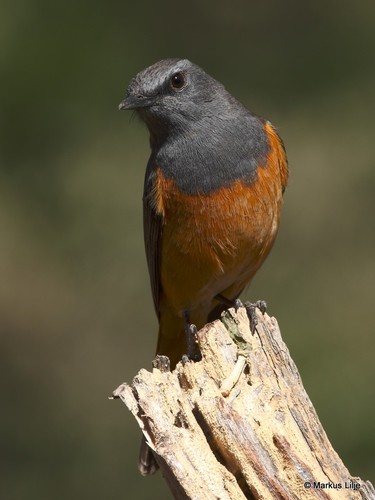
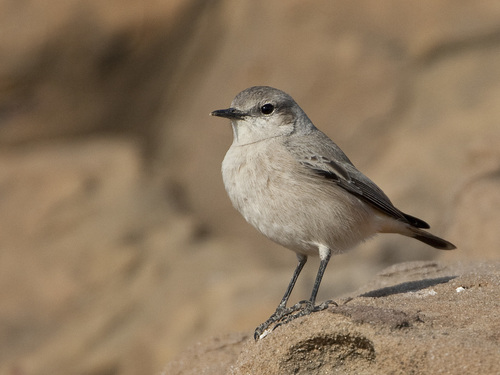
This species, Oenanthe chrysopygia, measures 14.5 cm in length, has a wingspan of 26–27 cm, and weighs approximately 20 to 27 grams. Its plumage is fairly drab: it is mainly grey-brown on the upperparts, and greyish-white on the underparts. It has a faint pale stripe running over its eye, a rufous tinge on its ear-coverts, and silvery-white underwing-coverts. The rump and the bases of the outer tail-feathers are reddish, while the rest of the tail is black, creating a distinct T-shaped pattern. There is very little physical difference between males and females, though the male has black plumage between the eye and bill. Female Kurdistan wheatears can be very similar in appearance to Oenanthe chrysopygia, but female Kurdistan wheatears usually have white bases to their outer tail-feathers. Adult male Kurdistan wheatears and some female Kurdistan wheatears are quite different in appearance, with black faces and throats, and greyer upperparts. The song of Oenanthe chrysopygia is a simple repeated whistle, and the bird produces a range of clicking, rasping, and whistling calls. Its breeding range stretches from northeast Turkey, Armenia, and Azerbaijan eastward through Iran to Afghanistan, southern Tajikistan, and western Pakistan. It is a migratory species that travels south to winter on the Arabian Peninsula, in Eritrea, in southern Iraq and Iran, in Pakistan, and in northwest India. It has been recorded as a vagrant in Israel, Ethiopia, Djibouti, and Nepal. It breeds in mountainous areas at elevations between 1,200 and 4,000 meters above sea level, and nests on steep, barren, rocky ground with very little vegetation. It winters at lower elevations, where it occurs on rocky hills, in steppe, scrubland, and semi-desert habitats.