About Oemona hirta (Fabricius, 1775)
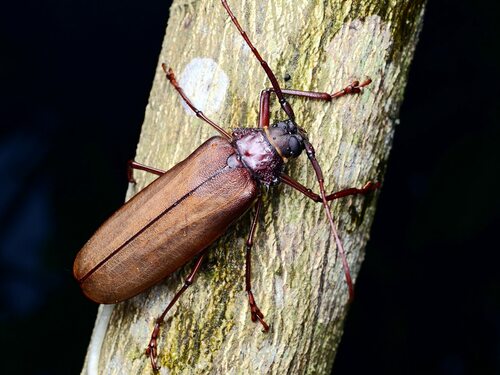
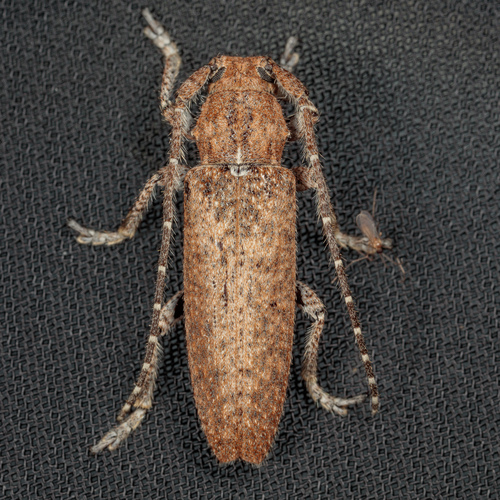
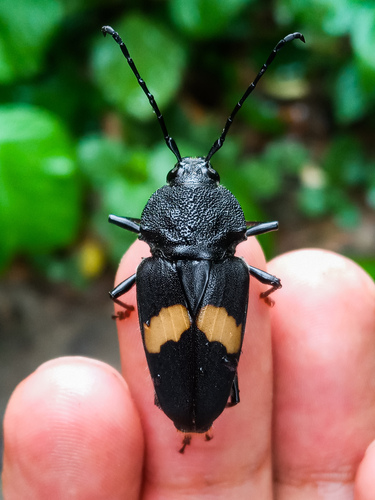
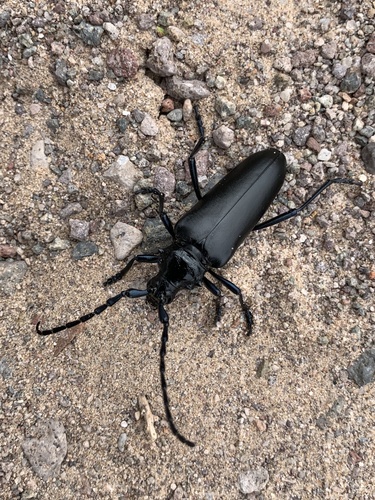
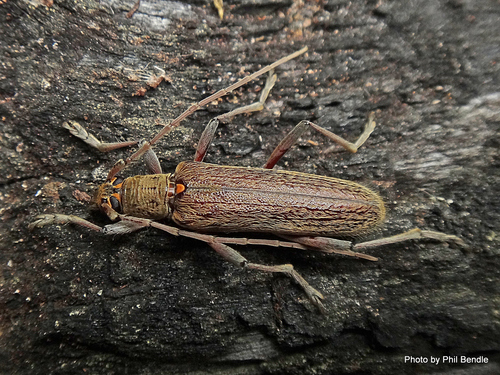
Oemona hirta (Fabricius, 1775), commonly known as the lemon tree borer, is a species of longhorn beetle in the family Cerambycidae. Worldwide, the Cerambycidae family contains over 33,000 species, and there are an estimated 200 to 300 species of longhorn beetles in New Zealand. Cerambycidae larvae are known for damaging hardwood, making newly introduced species major economic threats to timber and horticultural industries. Adult lemon tree borers are plain-looking, medium-to-large beetles that measure 15 to 25 mm (0.6–1.0 in) long. They have slender bodies with elongated antennae that are usually the same length as the body or longer, and can be held in front of the body or curved backward against it. Adult body colour ranges from red-brown to almost black, with patches of pale yellow hairs on the head and the scutellum, the small spot on the back where the thorax joins the hard wing cases (elytra). Females are larger and heavier than males, and have proportionally shorter antennae, but sex can only be reliably determined by examining the genitalia under a microscope. A distinctive feature of O. hirta is transverse wrinkling on the dorsal surface of the pronotum, which is especially prominent in males. Eggs of O. hirta are white and large at 2.0-2.2 mm, with a fine waxy surface pattern. They are laid singly in leaf or stem junctions, pruning scars, cicada scars, damaged bark, or dead twigs on the outer edge of host trees. Larvae have a white to pale cream body with visible orange to brown gut contents, and reach 25-40 mm long when fully grown. They have a cylindrical body, with a swollen transverse ridge on each thoracic and abdominal segment. Their enlarged head holds large but short, dark brown to black, gouge-like biting mandibles. Many tiny rigid brown hairs line the lateral edges of the body, especially near the head. When disturbed, larvae can move surprisingly quickly, using dorsal and ventral muscle ridges to grip their surroundings. Pupae are approximately 20-25 mm long, and are a pale reddish clay colour with darker shading on the wing cases. The pupal chamber forms from a short section of an existing larval tunnel, with tightly packed wood shaving plugs blocking each end. The developing beetle’s shape is visible in the pupal stage, with long antennae folded next to the body and larger legs bent inward. While pupating, the individual can twist around inside its chamber using small black spines on its abdomen. Oemona hirta is endemic to New Zealand, and has not established permanent populations outside of the country, though a small number of individual specimens have been intercepted overseas: the Food & Environment Research Agency identified individuals in the UK in 1983 and again in 2010. The 2010 specimen was found on an imported wisteria plant from New Zealand, and O. hirta is classified as a potentially devastating agricultural pest if it were to become established outside New Zealand. Within New Zealand, this native species is the most commonly encountered longhorn beetle. While it was previously assumed to be widespread across the whole country, it is mainly located in the North Island and the North-West Nelson region of the South Island. It has been collected from sea level up to altitudes of over 1,200 m (3,900 ft), and has also been found on several offshore New Zealand islands including Kapiti Island and Mokopuna Island. Like most other longhorn beetles, lemon tree borers have good flying ability that allows them to colonize favourable habitat and spread widely. Adults fly mainly in early morning and evening, when most mating takes place. Lemon tree borers have a long life cycle that averages around two years, with most of their lifespan spent in the larval stage. Adult females lay eggs singly between September and January; eggs hatch between a few days and two weeks after laying, with most hatching in 9–13 days. After hatching, larvae immediately begin tunnelling into wood, moving first through sapwood then into heartwood to a depth of roughly 10-20 mm. Larvae occur at low densities, usually with only two individuals per host tree. As larvae consume wood, they create long tunnels with side galleries, and exit holes to expel frass and allow aeration that discourages fungal growth. They bore longitudinally along stems, heading toward the main stem or larger branch. Occasionally, larvae will bore all the way around a branch, causing girdling. While larvae can sometimes be found in dead trees, they prefer living trees, which provide the humidity and nutrition they need to successfully develop into adult beetles. The larval stage lasts one to two years depending on environmental conditions: larvae in milder environments with shorter winter periods pupate faster. Larvae reach roughly 15 mm long and mine approximately 150 mm of tunnel over their first summer. Larval activity slows during winter, and increases substantially around October when temperatures warm. Frass production increases in the second summer, as larvae reach full size. The pupal stage lasts 2–3 weeks, and can take up to several weeks total. Pupation begins between late May and early November, when larvae form a small chamber within their existing tunnel. Adults emerge from early spring to late summer, with most emerging between October and December. Newly emerged adults stay inside their pupal cells until their outer integument has hardened. Once they emerge, adults become sexually mature around four days later, though this timing varies with environmental conditions. Adults are mostly nocturnal, foraging and mating at night, and hide in vegetation during the day. They feed on plant pollen and nectar, and can live for around two months, though they often die shortly after reproduction.