About Oedura cincta De Vis, 1888
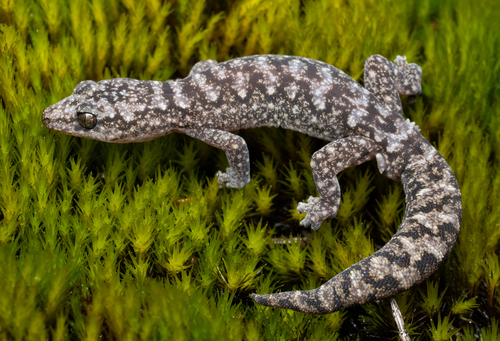
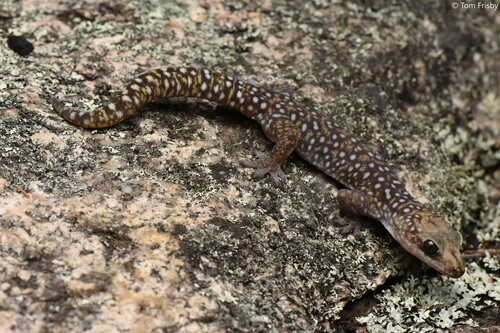
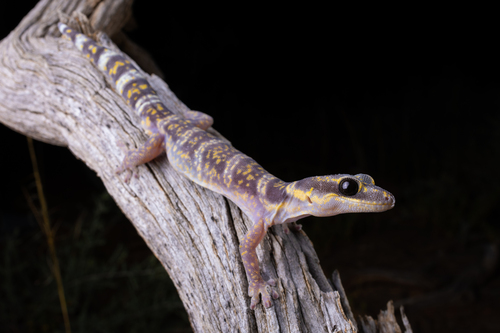
Oedura cincta, commonly called the inland marbled velvet gecko, has an average snout-vent length of 90 millimetres, and reaches a maximum length of 108 millimetres. This species has a thick tail, with five or six light bands crossing its body over a purplish brown background. The banding is particularly noticeable on juvenile individuals. As they mature into adults, light yellow flecking develops across their bodies, which makes the original banding less distinct. The tail can become thinner when the gecko experiences stress or poor body condition. Adult Oedura cincta have a purple brown base colour during the day, and shift to a duller grey appearance at night. They can be told apart from the morphologically similar species Oedura marmorata by their longer overall body length, plus a longer, slimmer tail that is never thicker than the head. Oedura cincta has a wide distribution across central Australia and inland eastern Australia. It is an arboreal and rock-dwelling species that most often inhabits granite, quartz, sandstone, and limestone rock formations, as well as trees. The eastern evolutionary significant unit (ESU) lives in woodland areas of western New South Wales and Queensland, across the Cooper and Darling basins. This population mostly resides in tree hollows and the bark of small trees, predominantly Casuarina species. When rock habitat is available, eastern ESU individuals will also live there, and have been recorded in this habitat in the Flinders Ranges. A greater proportion of Oedura cincta are arboreal in inland eastern Australia (the eastern ESU), while rock-dwelling lineages belong to the central ESU, which has a smaller, less widely distributed range mostly restricted to central Australia. Two isolated populations of the central ESU have been identified in southern Northern Territory, in the Macdonell and Reynolds Ranges, and these populations are predominantly rock-dwelling. Oedura cincta is oviparous, meaning it lays eggs rather than giving birth to live young, and its average clutch size is thought to be two offspring.