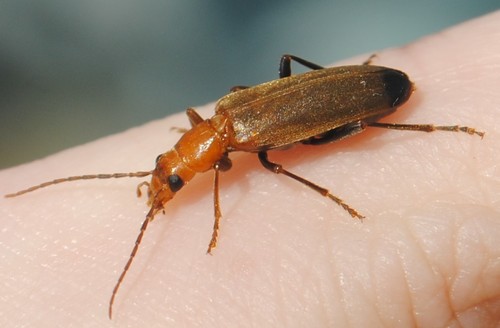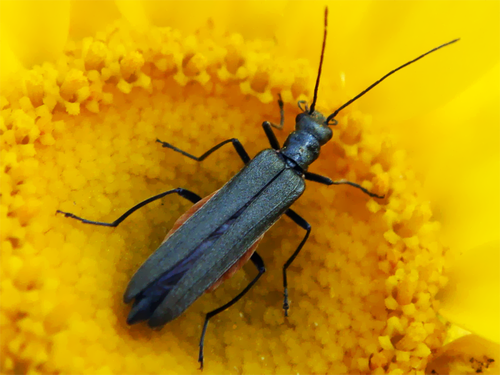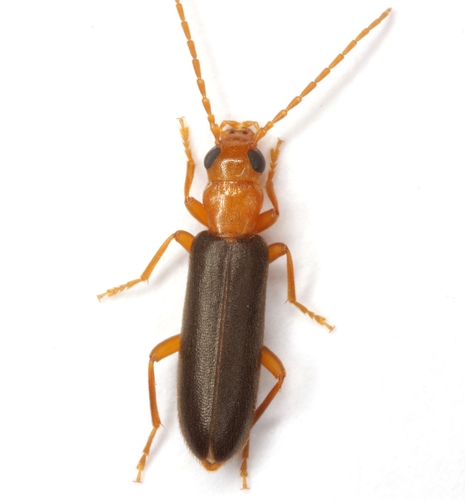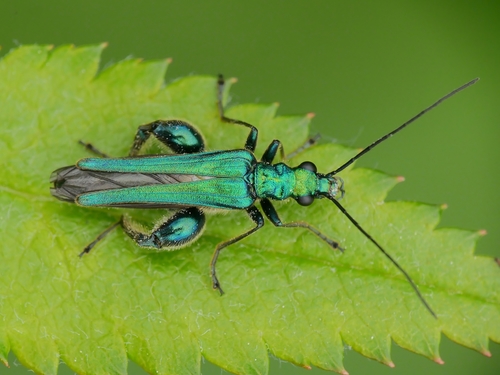
About Oedemera nobilis (Scopoli, 1763)
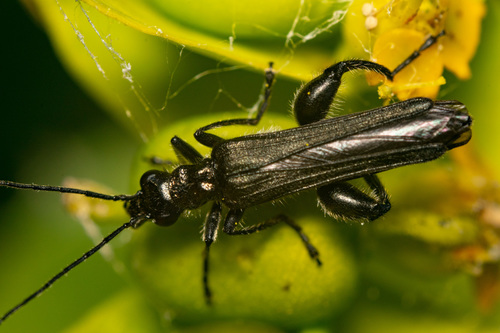
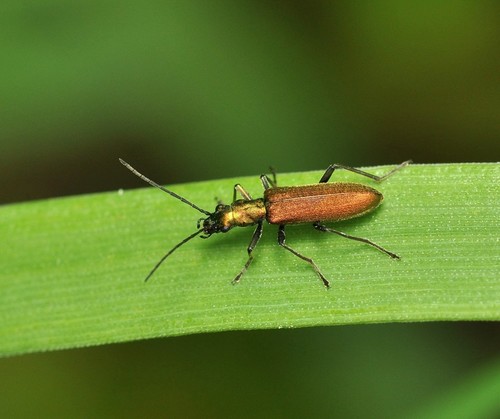
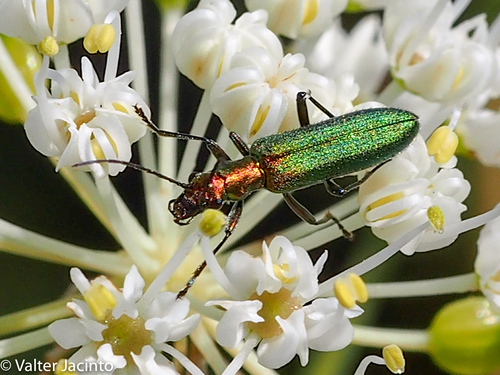
Morphology: Like most species in the Oedemera genus, male Oedemera nobilis have very swollen hind femora, while females have thin femora. Their elytra narrow strongly towards the apexes, and do not cover the membranous hind wings. The species is typically bright green, often with a golden or coppery sheen; some individual specimens are blue or violaceous. The only species it can be confused with is Oedemera flavipes, which does not inhabit the British Isles. Oedemera nobilis can be distinguished from Oedemera flavipes by its body colour, as well as by the long white pubescence found on the head, pronotum and hind tibiae of males. Distribution: This species is found in western and southern Europe, ranging from the Iberian Peninsula to Greece. It is common in Mediterranean countries, and occurs in Central Europe from western Germany through to Great Britain. It is rare and sporadic in Denmark, and has also been recorded in the Maghreb. It is not present in alpine countries or Eastern Europe. Since 1995, this species has been undergoing a distinct phase of range expansion and population consolidation in England and Wales. Biology and ecology: Oedemera nobilis is abundant on a variety of flower species during spring. Males are very noticeable due to their swollen femora and bright green colour. They feed on pollen and nectar from plants in the following families: Asteraceae, Cyperaceae, Convolvulaceae, Cruciferae, Dipsacaceae, Scrophulariaceae, Poaceae, Papaveraceae, Plantaginaceae, Rosaceae, Rubiaceae and Apiaceae. The larvae of Oedemera nobilis develop on the dry stems of Spartium and Cirsium.