About Oecobius navus Blackwall, 1859
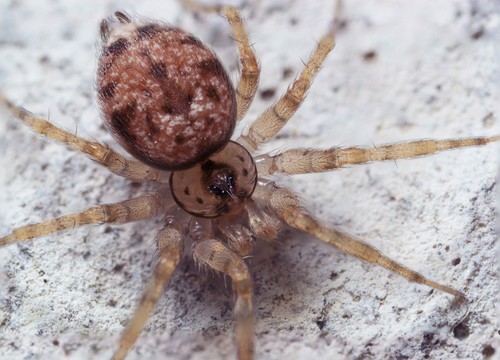
Both adult male and female Oecobius navus are approximately the same size, with a body length of 2–2.5 mm (0.08–0.10 in). Their carapace is almost circular and pale brown, with a dark patch in the centre that sometimes extends to the ocular region, plus a thin black marginal line. The abdomen is yellowish brown, marked with black spots overlaid on smaller white flecking. This species has long posterior spinnerets, with a tubule located between them. The legs are short and share the same pale brown colouring as the carapace; they range from unmarked to having distinct dark annulations. Oecobius navus has eight eyes total: the posterior median eyes are reduced to flat, irregular silver patches, while the remaining six eyes are grouped into two pairs of three. Oecobius navus is native to Europe and Northern Africa, and has been introduced to South Africa, China, Korea, Japan, New Zealand, and the Americas. It builds flat webs with lateral openings, reaching about 3 cm in diameter, under rocks, on ceilings, and along the corners of walls, with protruding signaling threads. Before copulation, the male constructs a tubular mating web above the female's retreat. He then attempts to entice the female into the web; if she joins him inside, they mate. Like many spider species, the female may cannibalize the male during or after copulation. After mating, the female spins several small egg sacs, each holding 3–10 eggs, and then abandons the sacs.