About Odorrana graminea (Boulenger, 1900)
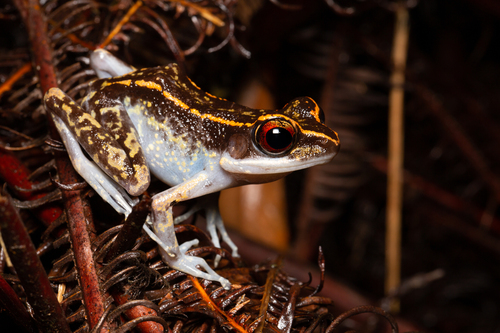
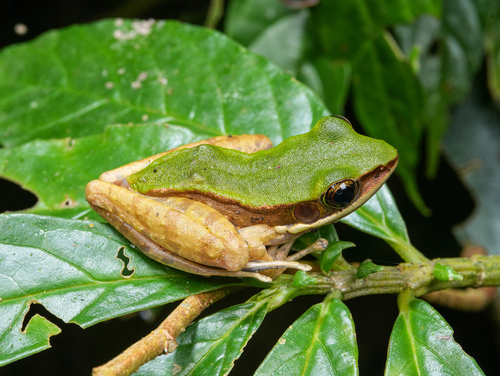
Odorrana graminea (Boulenger, 1900) have dorsoventrally compressed bodies and large eyes. Their dorsum is green with smooth skin, while their flanks are brown with yellow marbling and slight granulations. This is a relatively large frog species, with marked sexual size dimorphism: females reach a snout-vent length of 78–100 mm (3.1–3.9 in), while males only grow to 42–53 mm (1.7–2.1 in). Beyond size difference, males also differ from females in having smaller digital disks, stronger forearms, a larger tympanum, velvety nuptial pads on the thumb, and paired gular pouches below jaw articulations. Odorrana graminea can produce ultrasonic calls, a trait that is very rare among non-mammalian vertebrates, also documented in the closely related concave-eared torrent frog Odorrana tormota. However, unlike O. tormota, O. graminea does not have recessed ears, a feature previously thought to be important for ultrasonic hearing. The mechanism that allows O. graminea to detect ultrasound remains undetermined. Male Odorrana graminea produce a wide variety of ultrasonic harmonics above 20 kHz, and this species is one of the few non-mammalian vertebrates able to detect this frequency range. Currently, Odorrana graminea, Huia cavitympanum, and O. graminea's close relative Odorrana tormota are the only known frog species confirmed to be able to detect ultrasonic waves. Both O. tormota and O. graminea share a thin tympanic membrane that may be involved in their ultrasonic detection ability. Notably, ultrasonic communication is limited to males of this species; females cannot detect ultrasonic frequencies. It has been hypothesized that O. graminea's ability for ultrasonic communication evolved because the species naturally lives near noisy streams and waterfalls, a habitat niche shared by all three known ultrasonic frog species. Most biotic and abiotic background sounds in this habitat fall at frequencies far below the ultrasonic range, so ultrasonic communication allows O. graminea to distinguish intraspecific communication from background noise, helping them effectively locate other conspecific males. Odorrana graminea is found in southern China, ranging from southern Anhui and northern Zhejiang west to extreme southern Gansu, southeastern Sichuan, and southern Yunnan at the border of Vietnam, Laos, and Myanmar; it has not yet been recorded in Laos and Myanmar. Its type locality is Wuzhi Mountain on Hainan. Before the 2003 revision of the taxon "Rana livida", this species was considered a synonym of Odorrana livida. It occurs near fast-flowing rivers and streams in montane subtropical or tropical forests. Rampant deforestation has caused habitat loss and subsequent population declines for many amphibian species, including Odorrana graminea. Documented ecosystem stressors affecting this species include residential and commercial development, agriculture, aquaculture, and biological resource use such as logging and wood harvesting. Research on the closely related species Odorrana morafkai on Vietnam's Langbian plateau found decreased population density in highly disturbed sites, while no such decrease was observed in moderately disturbed or undisturbed sites. No clear relationship between diet composition and habitat disturbance was found, and prey availability did not differ significantly across sites with different levels of habitat disturbance. This indicates that factors other than prey availability contribute to the observed gradient in population density across disturbance levels.