About Odontotaenius disjunctus (Illiger, 1800)
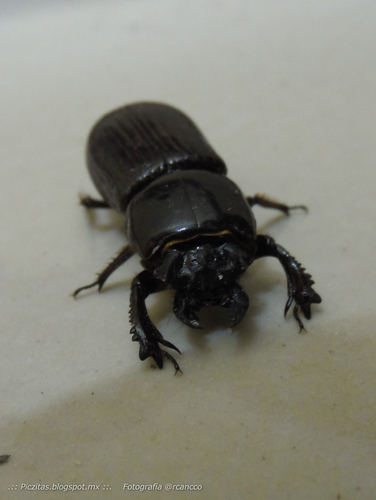
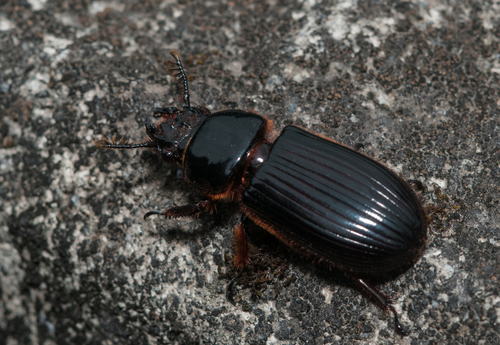
Odontotaenius disjunctus, commonly called the patent-leather beetle or horned passalus, is a saproxylic beetle belonging to the Passalidae family of bess beetles. Adults can grow to over 3 cm in length, weigh between 1 and 2 grams, and are capable of pulling 50 times their own weight. Since the early 1900s, this species has been used to study many general characteristics of the Passalidae family, but it remains relatively understudied within the diverse order Coleoptera.
Odontotaenius disjunctus is most commonly found in high-humidity climates, mainly in the warmer regions of both hemispheres, and is also widely distributed in temperate North American forests. These beetles are usually found under or inside old logs or stumps, and are rarely seen outside of their wooden habitats.
These beetles create tunnels in wood; they mate, lay eggs, and care for their offspring inside these tunnel galleries. Adult beetles feed larvae a chewed mixture of wood chips and feces. Larvae are unable to feed themselves, and take a full year to complete development. As a presocial beetle species, larvae are typically cared for by both parents and older young offspring. This cooperative brood care benefits all members of the group: larvae receive consistent high-quality care, and young adult offspring can stay in the burrow to improve their fitness while waiting for favorable conditions before leaving the log. Offspring depend heavily on parental care for both protection and nourishment, because parents mix food with their own secretions before larvae can eat it.
Reproduction in this species is affected by seasonality; females lay the majority of their eggs during the summer months. Odontotaenius disjunctus forms permanent monogamous pairs. During the breeding season, which runs from early spring to late summer, pairs mate repeatedly and produce 20 to 35 eggs over the course of the season. Offspring stay in the parental tunnel for the rest of the year, overwinter inside the log, and then disperse the following late spring. Infanticidal behavior has been observed in this species; it most often occurs when an unmated male or female takes over an existing burrow, since empty burrows are limited.