About Odontosia carmelita (Esper, 1799)
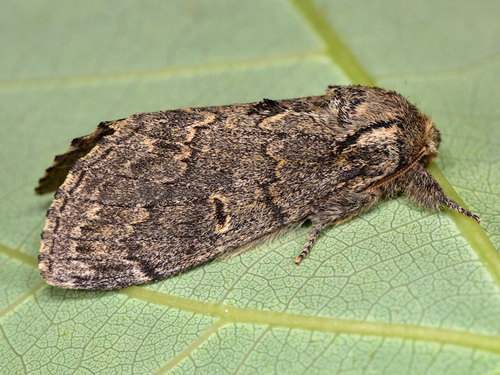
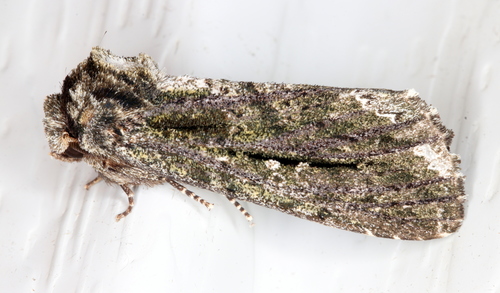
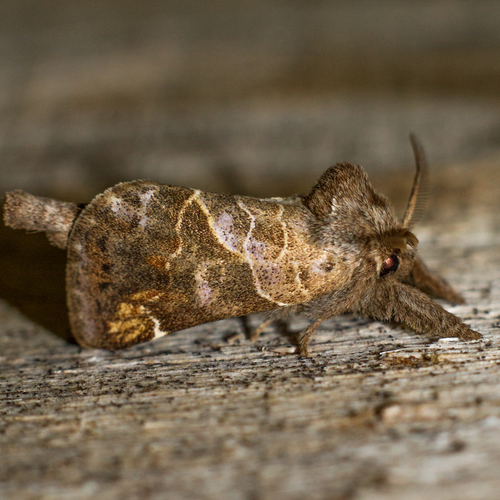
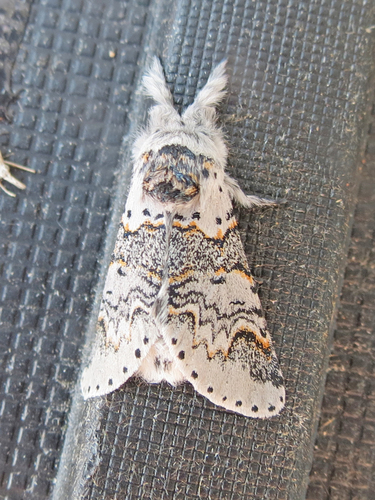
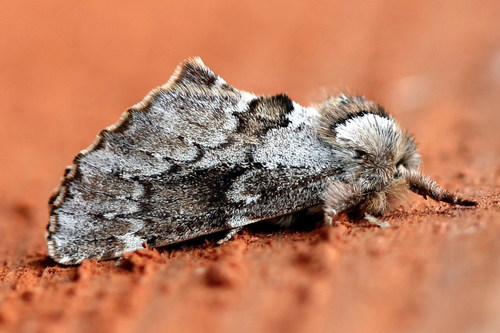
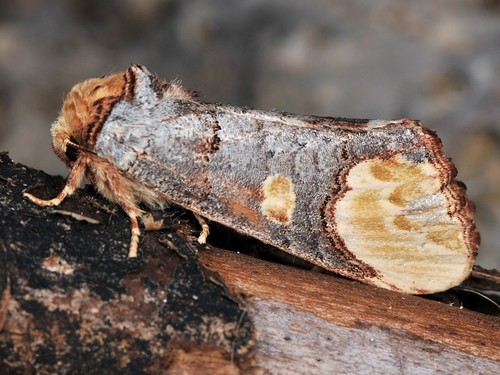
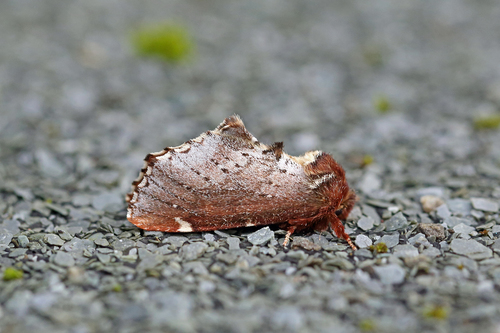
Odontosia carmelita, commonly called the scarce prominent, is a moth species in the family Notodontidae. It was first described by Eugenius Johann Christoph Esper in 1799 under the basionym originally dated 1798. This species has a wingspan of 32–42 mm. Overall wing colour is graded across various shades of reddish brown or purplish grey. The forewings are scalloped, bear faint pale points formed by grey scales, and have a distinct creamy patch on their front margin. The hindwing is paler than the forewing, with a dark brown patch at the anal angle. The thorax and body are dark brown. Additional detailed morphological description from Seitz notes that only male antennae are dentate and ciliate. The thorax is dark brown, with the hind margin of the patagia grey, and the abdomen is light brown. The forewing is dark brown with a reddish tone, darkest on the anterior half; the posterior and outer areas are strongly suffused with whitish grey. There is a black-brown tooth-shaped scale patch at the hind margin. At one-third and two-thirds of the costal margin, there are white spots marking the position of reduced transverse bands; the proximal spot is small and often diffuse. Usually only the outer transverse band is visible, marked by black vein-spots that each bear a white dot. Dark arcs filled with white run along the distal margin. The hindwing is somewhat lighter than the forewing, has a darkened anal angle and a narrow diffuse whitish median band. Odontosia carmelita is found across central Europe, sporadic and rare. It ranges north to Ireland, Finland and Southern Scandinavia, south to North-East Spain and Northern Italy, and east to Southern Russia and the eastern parts of the Carpathian Mountains. It is absent from Lower Austria and South-East Europe. In Norway, the species is represented by a distinct form, nordlandica Strand, described from Saltdalen in Nordland and published in 1907; this form is smaller, has a more grey ground colour without the reddish rust tone, and has very distinct transverse bands and costal spots, with the latter being prominently black and white. This form is currently treated as a synonym of the main species. The egg is bluish white, minutely dotted with fuscous. The larva is yellowish green, with numerous low yellow prominences on its back arranged in four longitudinal rows. The spiracles are intensely black, and each has a dark bright red spot. A whitish longitudinal streak connects the stigmata of the anterior and posterior segments, and this streak is absent from the median segments. Larvae occur from June to August, living on the top branches of birches. The pupa is black-brown, and develops inside a cell in the ground lined with a thin layer of silk. Adult moths fly from April to May, or from March to May depending on location. Larvae of this species feed on Betula (birch) and Alnus (alder) species.