About Odontophorus gujanensis (J.F.Gmelin, 1789)
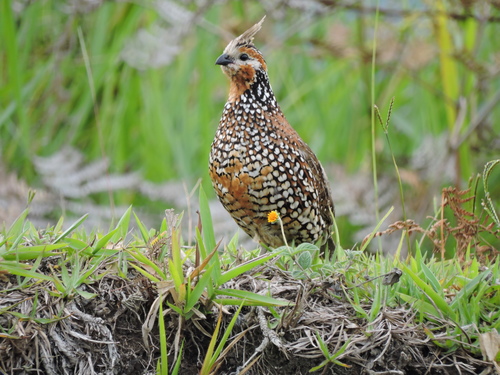
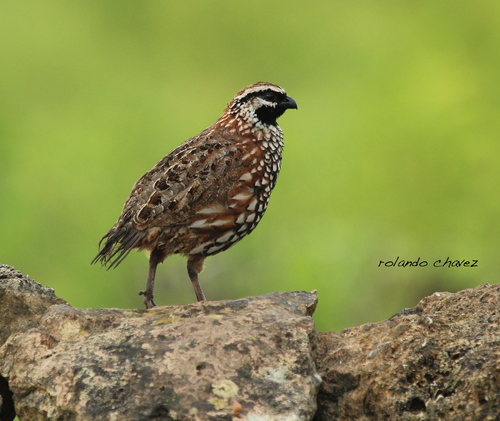
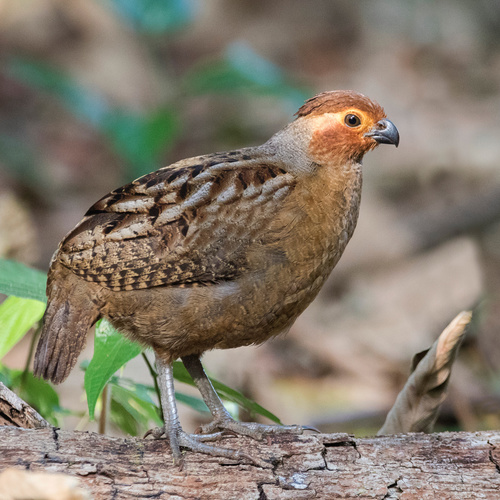
Odontophorus gujanensis, commonly known as the marbled wood quail, has the following physical description. Adult marbled wood quails reach a length between 23 and 29 cm, equal to 9 and 11 inches. They have a stout, dark-coloured bill, and bluish-grey legs and feet. Their eye iris is brown, and there is bare orange or red skin surrounding the eye. The sexes look very similar. The front of the crown and the cheeks are reddish-brown. The dark brown, vermiculated feathers of the crown are ruffled to form a short, loose crest. The mantle and neck are greyish-brown, the back and wings are brown with black vermiculations, and the rump and upper-tail coverts have indistinct paler spotting. The underparts are drab brown, with some indistinct barring in buff and darker brown. Juvenile birds resemble adults, but differ in having reddish-orange bills and non-vermiculated, reddish-brown crests. This species has a large range across Central America and northern South America. Its distribution extends from Costa Rica and Panama (where it is feared extinct) to Colombia, Venezuela, Peru, the Guianas and Brazil. It is a ground-dwelling bird that lives in the undergrowth of lowland rainforests and cloud forests. Its maximum elevation range varies by country: it occurs up to 900 m (3,000 ft) in Ecuador, and up to 1,500 m (4,900 ft) in both Colombia and Venezuela. The marbled wood quail is an elusive bird that moves through undergrowth and is rarely seen, though its distinctive calls can often be heard, especially at dawn and dusk. It sometimes comes out into open areas but stays close to fallen trees or scrub to make retreat easy. When disturbed, it typically moves away quietly on foot, but will burst into flight if needed. It usually lives in small groups that travel in single file, foraging through leaf litter for invertebrates and fallen fruits. Nests are sometimes found at the base of trees, built as a shallow scrape concealed under a roof of dead leaves, and hold about four white eggs, which may sometimes be spotted with brown. The timing of the breeding season varies depending on location.