About Odontophorus capueira (Spix, 1825)
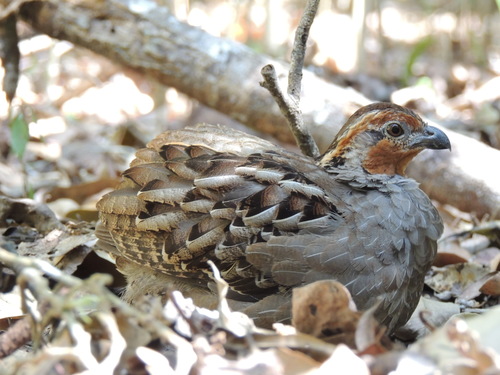
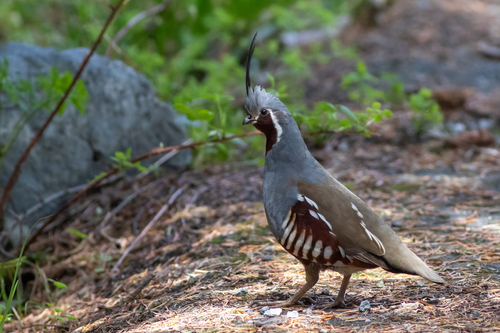
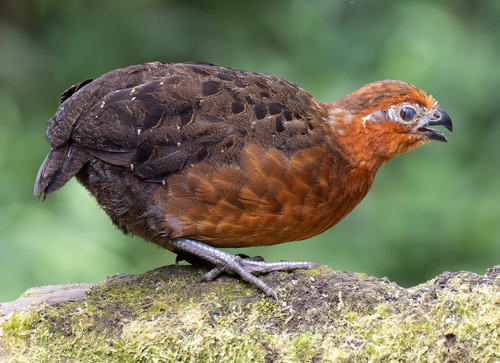
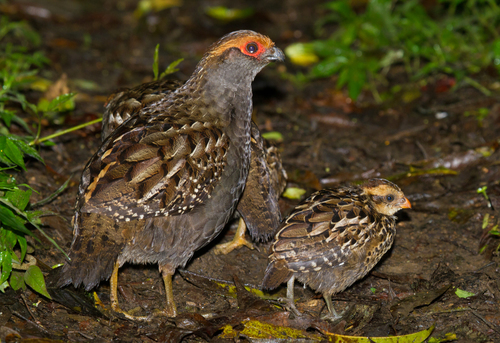
Male and female spot-winged wood quails (Odontophorus capueira) are similar in appearance, though females are slightly smaller. This species has a reddish-brown speckled-buff crown with a loose crest, a reddish-cinnamon supercilium (stripe above the eye) and chest-band. Its upper parts are greyish-brown, marked with dark vermiculations and speckling; individual feathers on the neck, mantle, back and scapulars have white streaks alongside the shaft. The sides of the head, throat and underparts are slatey-grey. Legs are dark grey, the bill is blackish, the iris is brown, and the bare area around the eyes is red. Adults measure 26 to 30 cm (10 to 12 in) in total length. Juveniles have similar base colouring, but differ by having reddish bills, more heavily speckled upper parts, and grey underparts flushed with rust and speckled with white. The spot-winged wood quail is native to eastern and southeastern Brazil, extreme northeastern Argentina, and eastern Paraguay. It inhabits dry lowland forest (including secondary forest) at altitudes up to 1,600 m (5,200 ft). Spot-winged wood quails typically move on the ground during the day in small groups of six to eight individuals, though groups may sometimes reach up to fifteen members. When disturbed, they retreat into undergrowth and rarely fly, especially when the group includes chicks; birds will sometimes freeze and crouch instead. Their diet includes fallen Araucaria and other tree nuts, pokeweed and other plant berries, and likely also includes invertebrates. At night, these birds roost in trees well above the ground. This species is monogamous, and breeding occurs between August and November. The nest is built on the ground, with a side entrance and a roof made of dead leaves. Clutches contain around four white eggs that become discoloured soon after laying. The female incubates the eggs, which hatch after approximately eighteen days, and rears the chicks without assistance from the male.