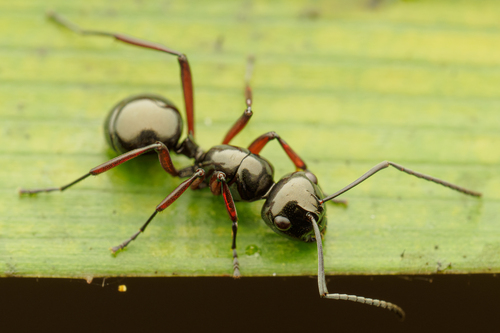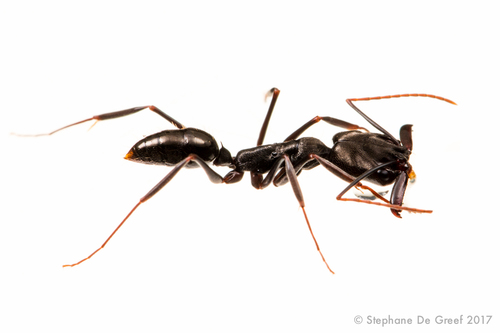
About Odontomachus bauri Emery, 1892
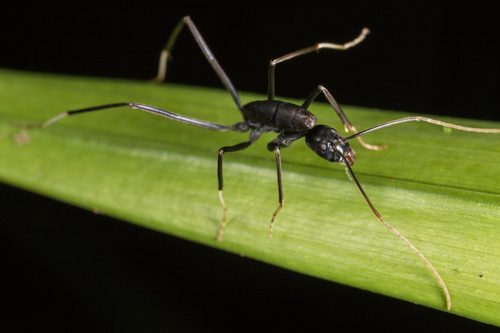
Odontomachus bauri Emery, 1892 can be identified by several key traits. Its primary identifying characteristic is a dark brown body color. The area from the face to the near margin of the vertex is striated. The head length ranges from 2.09–3.12 mm (0.082–0.123 in). The first gastral tergum has pubescence (hair), which is partially erect, and the hairs are relatively uniform in size and placement. When viewed from the side, the petiolar node is dome-shaped. Like other species in the Odontomachus genus, the larvae of O. bauri have ornamentation of spines and adhesive pads, but they have distinct unique features in their minute sensilla and the relative size of their body structures. Larvae go through three larval stages before molting, and do not spin a cocoon.
This ant species occurs from southern Costa Rica across tropical South America, the West Indies (excluding Cuba and the Bahamas), the Galapagos Islands, and northern Mexico. It is also one of the most common ant species around homes and gardens in southern Brazil. O. bauri is most frequently found in lowland habitats, most often residing in tropical rainforests. Compared to many other Odontomachus species, O. bauri is more tolerant of dry conditions. It typically builds nests in soft, humid soil in spots that are protected from direct sunlight, and have a low chance of natural disturbance from factors like wind and rain. Nests can often be found under rocks, branches, and fallen tree trunks. In garden settings where this species occurs, nests are usually located under rocks, within plant containers, or among vegetable residues.