About Odontolabis cuvera Hope, 1842
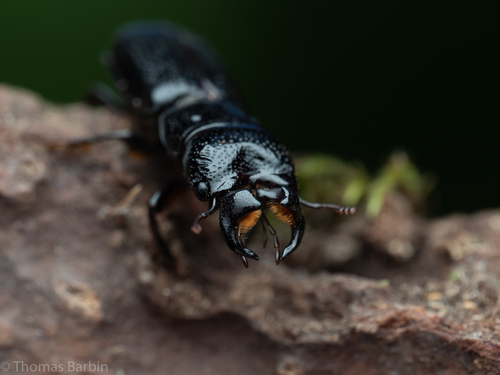
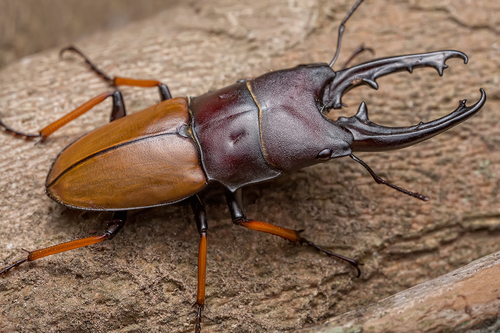
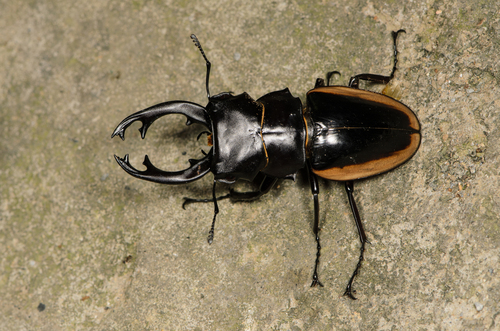
Odontolabis cuvera (Hope, 1842) shows clear sexual dimorphism in body size and mandible shape. Including mandibles, males reach a total length of approximately 43–90 millimetres (1.7–3.5 in), while females reach 41–51 millimetres (1.6–2.0 in). Males have a conspicuously large, elongated pair of mandibles, which females do not possess. This species has a basic black body color, with broad orange margins along the outer edges of its elytra; females match males in overall coloration. The pronounced size and shape difference between males and females evolved via sexual selection to help males secure access to mates for breeding. Odontolabis cuvera also displays male trimorphism: males occur in three distinct morphological forms that differ in mandible size. These three alternative male weapon phenotypes are considered conditional reproductive strategies. As of 2017, this species is only one of just two lucanid stag beetles documented to have this trimorphic trait, with the other species being Dorcus rectus. In the subspecies Odontolabis cuvera sinensis, the elytra are almost entirely black, with only a small orange border, and adult beetles of this subspecies can reach around 80 millimetres (3.1 in) in length. This beetle is native to southeast Asia, where it is found in Bhutan, China, India, Laos, Myanmar, Nepal, Thailand, and Vietnam. Females lay their eggs in leaf litter substrate and rotten wood. Larvae create tunnel systems within this substrate, where they remain and feed on decaying wood for several years during their development.