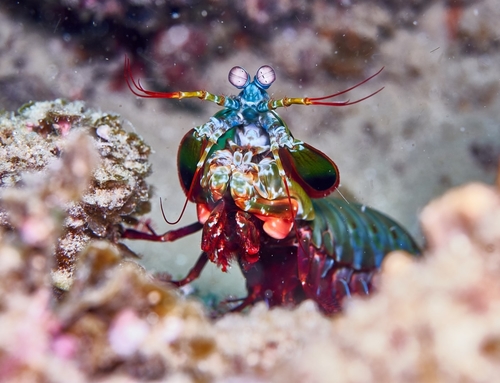
About Odontodactylus scyllarus (Linnaeus, 1758)
Odontodactylus scyllarus, commonly known as the peacock mantis shrimp, is one of the larger, more commonly encountered colorful mantis shrimp species. It ranges in size from 3 to 18 cm (1.2 to 7.1 in). Individuals are primarily green, with orange legs and leopard-like spots on the anterior carapace. This species can see circularly polarized light, and this ability has led to studies exploring whether the operating mechanisms of its eyes can be replicated for reading CDs and similar optical storage devices. Ecologically, Odontodactylus scyllarus is a burrowing species that constructs U-shaped burrows in loose substrate near the bases of coral reefs. It lives in the ocean’s benthic zone at depths ranging from 3 to 40 metres (9.8 to 131.2 ft). O. scyllarus is categorized as a smasher mantis shrimp, and has club-shaped raptorial appendages. It is an agile, active predator found in intertidal and sub-intertidal habitats, and prefers feeding on gastropods, crustaceans, and bivalves. It repeatedly delivers blunt force to its prey’s exoskeleton until it can access and consume the underlying soft tissue. This species is reported to deliver a punch that reaches over 50 miles per hour (80 km/h), which is the fastest recorded punch of any living animal. The acceleration of its strike matches that of a .22 LR bullet fired from a handgun: it reaches accelerations of over 100,000 m/s² (330,000 ft/s², more than 10,000 g), and strike speeds of over 20 m/s (66 ft/s). Each strike delivers 1,500 N (340 lbf) of force. The high speed of its raptorial appendage strike causes cavitation bubbles to form. When these bubbles collapse, they release a large amount of heat, temporarily raising local temperatures and weakening the prey’s armor. In addition, the surface of its hammer-like claw is made of extremely dense hydroxyapatite, layered in a structure that is highly resistant to fracturing. This structure is strong enough to break ordinary glass aquarium tanks. The unique composition of this claw is currently being investigated for potential bionic applications in material engineering.

