About Odocoileus virginianus (Zimmermann, 1780)
Scientific name: Odocoileus virginianus (Zimmermann, 1780)
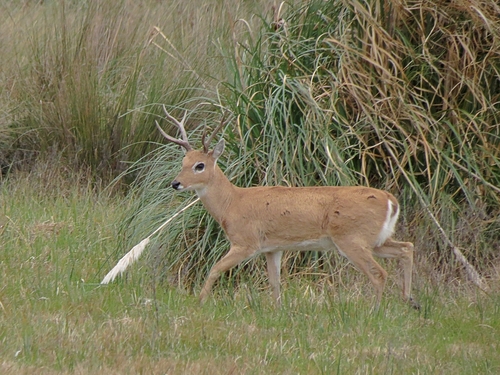
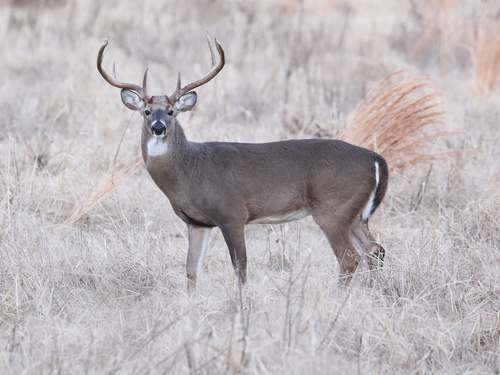
Description: The white-tailed deer has a reddish-brown coat in spring and summer, which changes to grey-brown in fall and winter. This species can be identified by the characteristic white underside of its tail; it raises this tail when alarmed to warn predators that it has been detected. A deer's age can be indicated by snout length and coat color, with older deer generally having longer snouts and grayer coats. One population of white-tailed deer in New York is entirely white (not albino) except for its nose and hooves. The former Seneca Army Depot in Romulus, New York hosts the largest known concentration of these white deer, and strong conservation efforts have let the white deer thrive within the depot's boundaries. The species' horizontally slit pupil supports good night vision and daytime color vision. White-tailed deer process visual images much faster than humans, and are better at detecting motion in low-light conditions.
Distribution: In North America, white-tailed deer are very common, even considered a nuisance in some areas, across states east and south of the Rocky Mountains, including southwestern Arizona. They are absent from the American West Coast and Baja California Peninsula, where the black-tailed deer (in the Pacific Northwest) or mule deer (Odocoileus hemionus) fill their ecological niche. This exception does not apply to mixed deciduous riparian corridors, river valley bottomlands, and lower foothills of the northern Rocky Mountain region, which extend from Wyoming west to eastern Washington and eastern Oregon, and north to northeastern British Columbia and southern Yukon, including Montana valley and foothill grasslands. The westernmost population of the species, the Columbian white-tailed deer, was once widespread in the mixed forests along the Willamette and Cowlitz River valleys of western Oregon and southwestern Washington. Current population numbers are much lower, and this population is classified as near-threatened by the IUCN. It is separated from other white-tailed deer populations. Among all U.S. states, Canadian provinces, and Latin American countries, Texas has by far the largest number of individual white-tailed deer, with an estimated population of 5.3 million that includes both wild deer and farmed herds raised for large antler rack size and breeding. High white-tailed deer populations are found on the Edwards Plateau of Central Texas, as well as in Illinois, Indiana, Iowa, Maryland, Michigan, Minnesota, Mississippi, Missouri, New Jersey, New York, North Dakota, Ohio, Pennsylvania, and Wisconsin. The conversion of land adjacent to the Canadian Rockies to agricultural use, alongside partial clear-cutting of coniferous trees that created widespread deciduous vegetation, has benefited white-tailed deer and extended their distribution as far northwest as the Yukon. Populations around the Great Lakes have expanded their range north and westward, also due to agricultural land conversion, while local caribou, elk, and moose populations have declined. White-tailed deer are crepuscular, meaning they are most active at dawn and dusk, and rest sporadically throughout both day and night. Globally, white-tailed deer have been introduced primarily for sport hunting to New Zealand, Nova Scotia (where they killed off native caribou via brainworm), Prince Edward Island (where they have been eradicated), New Brunswick (they are native in some areas around the adjacent Quebec region), the Greater Antilles of the Caribbean (Cuba, Jamaica, Hispaniola, and Puerto Rico), and several European countries (mainly the Czech Republic, Finland, France, Germany, Romania and Serbia).
Ecology: White-tailed deer are generalists that can adapt to a wide variety of habitats. The largest individuals of the species occur in North America's temperate regions. The northern white-tailed deer (O. v. borealis), Dakota white-tailed deer (O. v. dacotensis), and northwest white-tailed deer (O. v. ochrourus) are among the largest animals, with large antlers. The smallest white-tailed deer occur in the Florida Keys and in partially wooded lowlands of the Neotropics. Though they are most commonly associated as forest animals that rely on relatively small openings and edges, white-tailed deer can also adapt equally well to life in more open prairie, savanna woodlands, and sage communities, such as those found in the Southwestern United States and northern Mexico. These savanna-adapted deer have relatively large antlers for their body size and large tails. There is also a noticeable size difference between male and female deer in savanna populations. The Texas white-tailed deer (O. v. texanus), which lives in the prairies and oak savannas of Texas and parts of Mexico, is the largest savanna-adapted white-tailed deer in the Southwest, with impressive antlers that can rival those of deer from Canada and the northern United States. Arizona white-tailed deer (O. v. couesi) and Carmen Mountains white-tailed deer (O. v. carminis) populations inhabit montane mixed oak and pine woodland communities. These two groups are smaller, but can still have impressive antlers for their size. White-tailed deer from the Llanos region of Colombia and Venezuela (O. v. apurensis and O. v. gymnotis) have antler dimensions similar to those of the Arizona white-tailed deer. In some western regions of North America, the white-tailed deer range overlaps with that of the mule deer. White-tailed incursions into the Trans-Pecos region of Texas have resulted in some hybrids. In the extreme north of the species' range, moose also use the same habitat in some areas. White-tailed deer may occur in areas also used by elk (wapiti), such as mixed deciduous river valley bottomlands, and formerly in the mixed deciduous forest of the eastern United States. In locations including Glacier National Park in Montana, several national parks in the Columbian Mountains (Mount Revelstoke National Park) and Canadian Rocky Mountains, and Yoho National Park and Kootenay National Park in the Yukon Territory, white-tailed deer are shy and more reclusive than the coexisting mule deer, elk and moose. Central American white-tailed deer prefer tropical and subtropical dry broadleaf forests, seasonal mixed deciduous forests, savanna, and adjacent wetland habitats over dense tropical and subtropical moist broadleaf forests. South American subspecies of white-tailed deer live in two types of environment. The first, similar to Central American deer habitats, consists of savannas, dry deciduous forests, and riparian corridors that cover much of Venezuela and eastern Colombia. The second is higher elevation mountain grassland/mixed forest ecozones in the Andes Mountains, ranging from Venezuela to Peru. Andean white-tailed deer retain gray coats year-round due to colder high-altitude weather, while lowland savanna forms retain reddish brown coats. Like their Central American relatives, South American white-tailed deer generally avoid dense moist broadleaf forests. White-tailed deer have been introduced to Europe since the second half of the 19th century, and a population in the Brdy area remains stable today. White-tailed deer were introduced to Finland in 1935. The introduction was successful, and the deer began spreading through northern Scandinavia and southern Karelia, competing with and sometimes displacing native species. The 2020 population of around 109,000 deer descends from four animals provided by Finnish Americans from Minnesota.
Reproduction: Female white-tailed deer enter estrus, commonly called the rut, in autumn, normally late October or early November, triggered mainly by shortening day length (declining photoperiod). Female sexual maturation depends on both population density and food availability. Young females often leave areas with high densities of males. Some does can reach sexual maturity as young as six months old, but the average age of maturity is 18 months. Copulation involves a brief copulatory jump. Females give birth to one to three spotted young called fawns in mid-to-late spring, generally May or June. Fawns lose their spots during their first summer, and weigh between 20 and 35 kg (44 to 77 lb) by their first winter. Male fawns are usually slightly larger and heavier than female fawns. For the first four weeks, mothers hide fawns in vegetation and nurse them four to five times a day. This strategy keeps scent levels low to avoid attracting predators. After about a month, fawns are able to follow their mothers on foraging trips. Fawns are usually weaned after 8–10 weeks, but rehabilitators and studies have recorded cases where mothers continue allowing nursing long after fawns lose their spots, for several months or until the end of fall. Males leave their mothers after one year, while females leave after two. Bucks are generally sexually mature at 1.5 years old, and will begin breeding even in populations with high numbers of older bucks.
Food web: When species are introduced to new ecosystems, they can potentially disrupt the existing food web. For example, when white-tailed deer moved north into Alberta, gray wolf populations increased. This butterfly effect was also seen in Yellowstone National Park, where rivers changed after wolves were reintroduced to the ecosystem. It is also possible that growing white-tailed deer populations could cause the species to become invasive for various plants in Alberta, Canada.