About Odocoileus hemionus (Rafinesque, 1817)
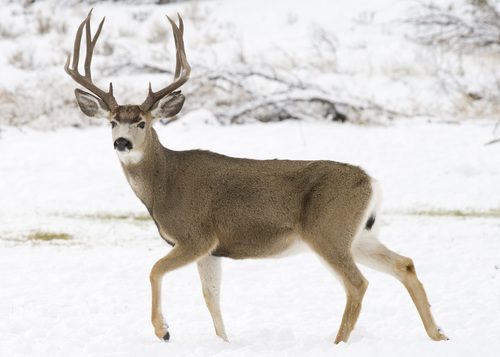
The most noticeable differences between mule deer (Odocoileus hemionus) and white-tailed deer are ear size, tail color, and antler configuration. Body size is also a key difference in many cases. The mule deer has a black-tipped tail, while white-tailed deer do not. Mule deer antlers are bifurcated, forking as they grow, rather than branching from a single main beam like the antlers of white-tailed deer. Each spring, a buck’s antlers begin regrowing almost immediately after the old antlers are shed. Shedding typically happens in mid-February, though the timing varies by location. While mule deer are capable of running, they are often observed stotting (also called pronking), landing on all four feet at the same time. On average, mule deer are the largest of the three species in the genus Odocoileus. They stand 80–106 cm (31–42 in) tall at the shoulders, and have a nose-to-tail length between 1.2 and 2.1 m (3.9 to 6.9 ft). The tail itself makes up 11.6 to 23 cm (4.6 to 9.1 in) of this total length. Adult bucks normally weigh 55–150 kg (121–331 lb), with an average weight around 92 kg (203 lb); trophy-sized specimens can weigh up to 210 kg (460 lb). Female mule deer (called does) are smaller, typically weighing 43 to 90 kg (95 to 198 lb), with an average weight around 68 kg (150 lb). Unlike white-tailed deer, mule deer generally do not have marked size variation across their range, though environmental conditions can cause large weight fluctuations within any mule deer population. The Sitka deer subspecies (O. h. sitkensis) is an exception to this pattern. This subspecies is noticeably smaller than other mule deer, with average weights of 54.5 kg (120 lb) for males and 36 kg (79 lb) for females.