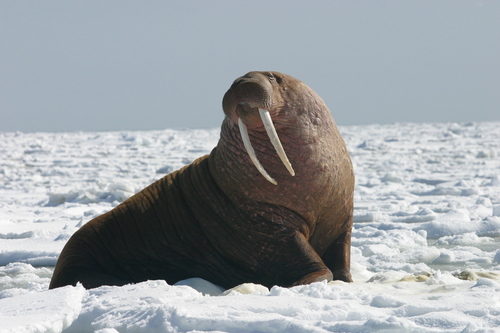
About Odobenus rosmarus (Linnaeus, 1758)
The walrus (Odobenus rosmarus) is a large pinniped marine mammal with a discontinuous distribution around the North Pole, found in the Arctic Ocean and subarctic seas of the Northern Hemisphere. It is the only surviving species in both the family Odobenidae and the genus Odobenus. This species is divided into two recognized subspecies: the Atlantic walrus (O. r. rosmarus), which inhabits the Atlantic Ocean, and the Pacific walrus (O. r. divergens), which inhabits the Pacific Ocean. Adult walruses are defined by prominent tusks, prominent whiskers, and large body size; adult male Pacific walruses can weigh more than 2,000 kilograms (4,400 pounds), and among all pinnipeds, only the two elephant seal species grow larger than this. Walruses mostly live in shallow waters over continental shelves, and spend large portions of their lives on sea ice searching for benthic bivalve mollusks to eat. They are social, relatively long-lived animals, and are classified as a keystone species in Arctic marine regions. The walrus has held a prominent place in the cultures of many indigenous Arctic peoples, who have historically hunted the species for meat, fat, skin, tusks, and bone. During the 19th century and early 20th century, walruses were widely hunted for their blubber, ivory, leather, and meat, and this hunting caused walrus populations to decline rapidly across the entire Arctic region. Populations have rebounded somewhat since this period of heavy hunting, though Atlantic and Laptev walrus populations remain fragmented and much smaller than they were before human interference. The majority of the Pacific walrus population spends the summer north of the Bering Strait, in the Chukchi Sea of the Arctic Ocean along the northern coast of eastern Siberia, around Wrangel Island, in the Beaufort Sea along the northern shore of Alaska south to Unimak Island, and in the waters between these locations. Smaller numbers of male Pacific walruses spend summer in the Gulf of Anadyr on the southern coast of Siberia’s Chukchi Peninsula, and in Bristol Bay off the southern coast of Alaska, west of the Alaska Peninsula. In spring and fall, walruses gather throughout the Bering Strait, spanning from the western coast of Alaska to the Gulf of Anadyr. They overwinter in the Bering Sea along the eastern coast of Siberia south to the northern part of the Kamchatka Peninsula, and along the southern coast of Alaska. A 28,000-year-old walrus fossil dredged from the bottom of San Francisco Bay shows that Pacific walruses ranged this far south during the last Ice Age. Commercial hunting reduced the Pacific walrus population to between 50,000 and 100,000 individuals in the 1950s to 1960s. Restrictions on commercial hunting allowed the population to grow to a peak in the 1970s to 1980s, but walrus numbers have declined again since that peak. Early aerial censuses of Pacific walruses conducted every five years between 1975 and 1985 estimated populations above 220,000 in each of the three surveys. In 2006, the Pacific walrus population was estimated at around 129,000, based on an aerial census combined with satellite tracking; in 1990, there were roughly 200,000 Pacific walruses. The far smaller Atlantic walrus population ranges across the Canadian Arctic, Greenland, Svalbard, and the western part of Arctic Russia. Based mostly on geographical distribution and movement patterns, eight hypothetical subpopulations of Atlantic walruses have been identified: five west of Greenland and three east of Greenland. Atlantic walruses once ranged as far south as Sable Island, off Nova Scotia; as recently as the 18th century, they occurred in large numbers in the Greater Gulf of St. Lawrence region, sometimes in colonies of 7,000 to 8,000 individuals. This southern population was nearly eliminated by commercial hunting; current numbers are difficult to estimate, but most likely remain below 20,000. In April 2006, Canada’s Species at Risk Act listed northwestern Atlantic walrus populations in Québec, New Brunswick, Nova Scotia, Newfoundland and Labrador as eradicated within Canada. A genetically distinct walrus population that once lived in Iceland was wiped out following Norse settlement around 1213–1330 AD. An isolated walrus population is restricted year-round to the central and western regions of the Laptev Sea, ranging from the eastern Kara Sea to the westernmost regions of the East Siberian Sea. The current population of these Laptev walruses is estimated at between 5,000 and 10,000. Although walruses can dive to depths greater than 500 meters, they spend most of their time in shallow waters and nearby ice floes hunting for bivalves. In the wild, walruses live around 20–30 years. Males reach sexual maturity as early as seven years old, but typically do not mate until they are fully developed at around 15 years of age. Males go into rut from January through April, dramatically reducing their food intake during this period. Females begin ovulating as early as four to six years old. Females are diestrous, coming into heat in late summer and around February, but males are only fertile around February; the potential fertility of the females’ late mating period is unknown. Breeding occurs from January to March, peaking in February. Males gather in the water around ice-bound groups of females in estrus, and take part in competitive vocal displays. Females join these groups, and copulation takes place in the water. Gestation lasts 15 to 16 months. The blastula remains in suspended development for the first three to four months before implanting in the uterus. This delayed implantation strategy, which is common among pinnipeds, is thought to have evolved to optimize both mating and birthing seasons around ecological conditions that improve newborn survival. Calves are born during spring migration, from April to June. They weigh 45 to 75 kg (99 to 165 lb) at birth and are able to swim immediately. Mothers nurse calves for over a year before weaning, but young walruses may spend up to five years with their mothers. Walrus milk contains higher amounts of fat and protein than milk from land animals, but lower fat content than milk from phocid seals. This lower fat content leads to slower growth rates for walrus calves, and means mothers must invest more time in nursing. Young walruses may be suckled both at sea and during long haul-outs on ice, making walruses the only pinnipeds that practice aquatic suckling. Ovulation is suppressed in females until a calf is weaned, so females give birth at most every two years. This gives walruses the lowest reproductive rate of any pinniped species.

