About Ocypode quadrata (Fabricius, 1787)
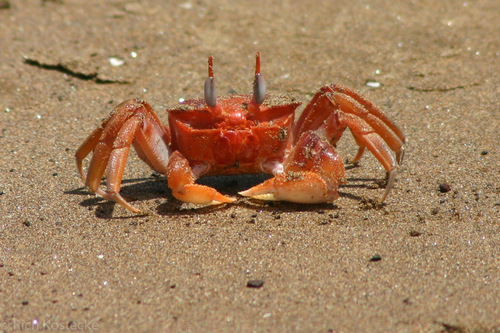
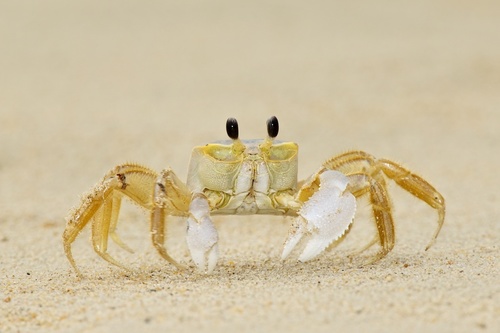
Mature adult Ocypode quadrata (Atlantic ghost crab) have a grayish or straw color, and reach around 5 cm (2.0 in) in width at maturity. Though they are mostly terrestrial, they must return to water periodically to moisten their gills, and also return to the sea to release their larvae. Their stalked compound eyes can swivel, giving them 360° vision. Young Atlantic ghost crabs have cryptic coloration that helps them blend into their sandy habitats.
Atlantic ghost crabs are distributed from Santa Catarina, Brazil north to Massachusetts, USA. They have been recorded on Block Island (Rhode Island), Nantucket (Massachusetts), Martha's Vineyard (Massachusetts), Delaware beaches, northern Virginia beaches, the Outer Banks of North Carolina, Fernando de Noronha, and Bermuda. Planktonic larvae of the species have been documented in Woods Hole, Massachusetts, even though adult crabs have not been recorded at this location.
The Atlantic ghost crab makes its home in sand burrows located above the strandline. Older crabs dig burrows farther from the ocean, with some located as much as 400 m (1,300 ft) inland. Burrows can reach up to 1.3 m (4 ft 3 in) deep, and may be closed off with sand during hot weather. This species can produce several different types of sounds: striking the ground with its chelae (claws), stridulating with its legs, and making a growling sound using the comb-like lateral teeth of its gastric mill. During mating rituals, male Atlantic ghost crabs do not use physical combat. Instead, they raise their claws and bodies in intimidating poses until one individual retreats, leaving the stronger crab to mate.
Atlantic ghost crabs are considered one of the fastest terrestrial invertebrates, able to run at speeds exceeding one meter per second (2.2 mph). Research on the gonadal regions of O. quadrata shows that while the species can breed year-round, reproductive activity peaks during the summer. O. quadrata is more active at night than during the day, and is an omnivore. Its diet includes clams such as coquina clams (Donax spp.), mole crabs including Emerita talpoida, insects, plant material, detritus, other crabs, and the eggs and hatchlings of sea turtles such as the loggerhead sea turtle.
Populations of Atlantic ghost crabs on sandy beaches have declined due to human activity. Human and vehicle trampling harms the species by directly crushing individual crabs, and causes indirect harm including sediment compression that reduces habitat suitability, interference with reproductive behaviors, reduced food supply, and light pollution. For this reason, Atlantic ghost crabs are typically less common on beaches that are frequently visited by people.