About Ocypode occidentalis Stimpson, 1860
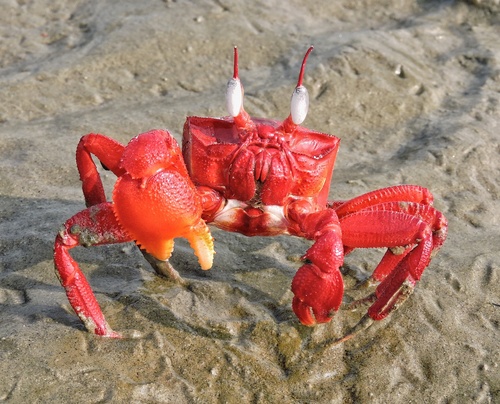
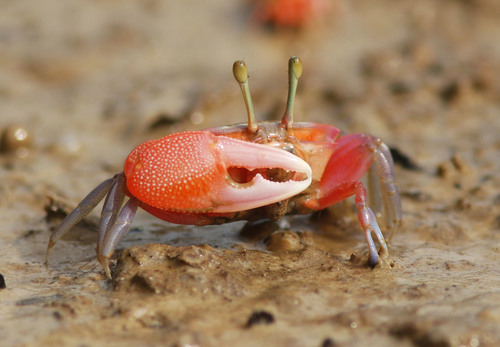
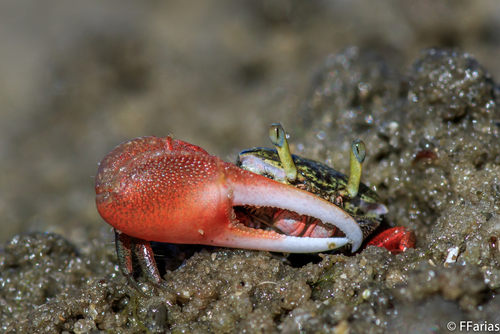
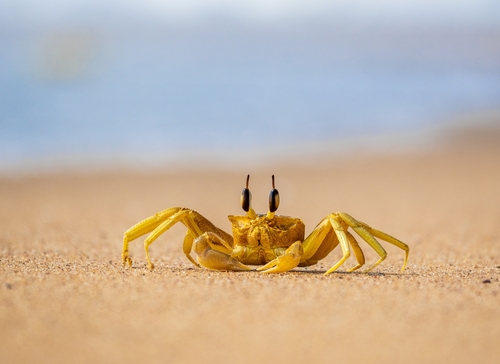
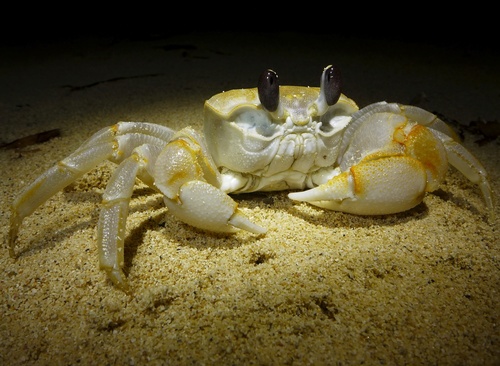
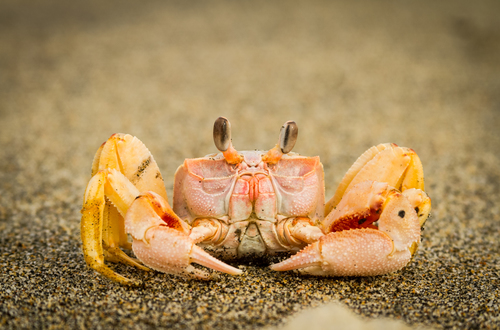
Gulf ghost crabs (Ocypode occidentalis Stimpson, 1860) are medium-sized ghost crabs with deep bodies, reaching a maximum overall body diameter of 6 inches (15 cm). The upper body surface is typically dark gray with lighter marbling, while the underside of the body, walking leg tips, and claws are creamy white. Their coloration varies and generally matches the color of the surrounding sand, though they are easier to spot on both black volcanic sand and light-colored dry sand. The carapace of gulf ghost crabs is squarish, wider than it is long, with an average length of around 43 mm (1.7 in) and width of 50 mm (2.0 in). It is thickly covered in small, rough bumps called tubercles. Their eyestalks are large and elongated, but lack the "horns" found on some other ghost crab species. The outer half of the eye socket margins curves distinctly inward, and the outer exorbital angles are triangular, ending in a sharp, forward-facing point. Like other ghost crabs, one of the gulf ghost crab’s claw appendages (chelipeds, the first pair of pereiopods) is much larger than the other. The palm of the larger cheliped is elongated, has a serrated lower edge, and is covered in tubercles on its upper surface. The inner surface of this palm has stridulating, sound-producing ridges that are an important trait for identifying different species in the subfamily Ocypodinae. In gulf ghost crabs, the stridulating ridge is short and made up of a row of 21 to 22 tubercles. The smaller cheliped tapers to a pointed end. The second pair of walking legs is no more than two and a half times the length of the carapace. The fourth walking leg pair is relatively smaller and weaker than the other three pairs, and only reaches the middle of the propodus of the third pair. The mera and carpi of all legs are hairless, but the propodi of the first three walking leg pairs have fur-like bristles called setae, and this feature varies by sex. In males, setae cover the upper forward surfaces of the propodi of the first and second walking leg pairs. The propodus of the third walking leg pair only has setae along its upper margin. In females, the upper surfaces of the propodi of the third and last walking leg pairs do not have bristles. The first gonopods, modified male copulatory organs, have a distinctively complex shape: they have a triangular cross-section at the base, and become hoof-like toward the tip. This is a diagnostic characteristic for the genus. The operculum, the covering of the female genital duct, is four-sided, membranous, and slightly calcified. The genital slit is narrow and aligned along the center of the operculum. Gulf ghost crabs are native to the eastern Pacific coast of the Americas, ranging from the Gulf of California to Colombia. They share the same range as the painted ghost crab (Ocypode gaudichaudii), and juveniles of both species smaller than 5 by 6 mm (0.20 by 0.24 in) are very difficult to distinguish. However, adults are easy to tell apart: painted ghost crabs are brightly colored and have "horns" (styles) on their eyestalks, which are not present in gulf ghost crabs. Painted ghost crabs also prefer sheltered rocky beaches, while gulf ghost crabs live on open sandy beaches. Gulf ghost crabs also look superficially similar to the Atlantic ghost crab (Ocypode quadrata), but the two species do not share a range, as Atlantic ghost crabs are only found on the western Atlantic coast of the Americas. Gulf ghost crabs construct burrows near the intertidal zone of open sandy beaches, and on sand and silt banks near river mouths that empty into the sea. Larger crabs typically have burrows further up the shore, while smaller crabs have burrows closer to the waves. They are nocturnal, and leave their burrows just after sunset. They are fast-moving generalist scavengers and predators, that usually feed on decaying fish and other crustaceans. They are also prolific predators of sea turtle eggs and hatchlings, including those of the olive ridley sea turtle (Lepidochelys olivacea) and the leatherback sea turtle (Dermochelys coriacea). At Playa Grande, Costa Rica, gulf ghost crabs have been observed to cause up to 48% of all deaths of newly hatched sea turtles as they cross the beach toward the ocean.