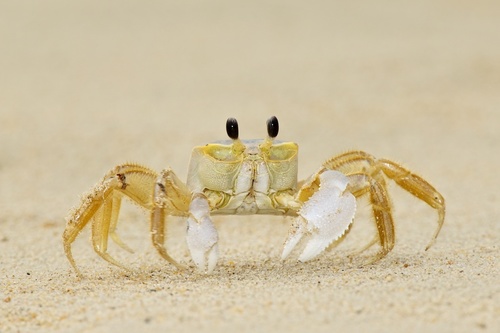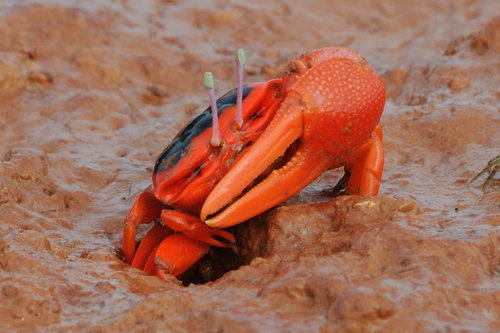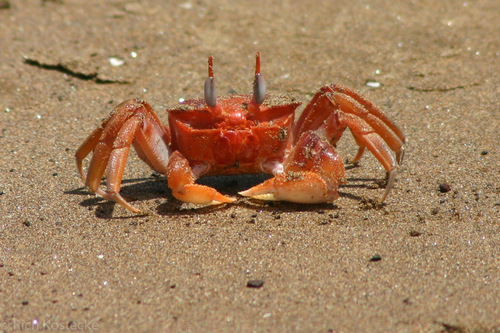
About Ocypode gaudichaudii H.Milne Edwards & Lucas, 1843
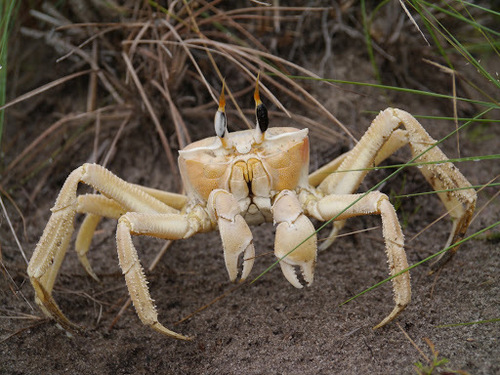
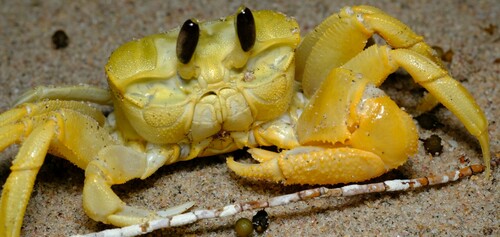
Ocypode gaudichaudii, commonly called the painted ghost crab, is an opportunistic feeder with three feeding behaviors: deposit feeding, scavenging, and predation. Its typical diet includes organic matter in sand, live organisms, and dead material from both ocean and terrestrial sources. Adult painted ghost crabs usually become specialized for deposit feeding, sifting through sand to collect organic food. They have specialized claws called truncated chelae that act as makeshift shovels for foraging in sand. These truncated claws allow the crabs to have a broader diet, feeding on both animals and diatoms. Most often, the major (larger) chela of the painted ghost crab is the left one. This differs from O. quadrata, another species in the same genus, which has a 1:1 ratio of right- and left-handed major chelipeds. While further research is still needed to fully understand cheliped laterality in brachyuran crabs, strong evidence indicates that cheliped laterality across the genus Ocypode is bimodal.
Like other land crabs, ghost crabs rely on gill chambers for respiration: air is drawn into these chambers through inspiratory openings, oxygen diffuses across the gills inside the chambers, and then enters the crab’s open circulatory system. Past studies on aerial respiration in land crabs found that the five species studied showed a slow respiration response to exercise. However, O. gaudichaudii’s respiration and oxygen uptake response to exercise is more similar to mammals, with high aerobic responses, unlike what was previously recorded for other land crab species. This high level of aerobic respiration directly contradicts the common theory that crustacean oxygen transport systems are inefficient. It also suggests that the main energy source for continuous movement in ghost crabs like O. gaudichaudii is aerobic ATP, similar to mammals and other animals that use aerobic ATP the same way.
Crabs of the genus Ocypode use acoustic signals, including airborne sounds and vibrations of surrounding substrates produced by rapping or stridulating, as part of reproductive behavior. Nocturnal vibrational signals produced by male Ocypode crabs are an important part of courtship and reproduction.
Both male and female painted ghost crabs dig burrows, which provide critical protection: they let crabs avoid predators, rapid environmental changes, and other territorial conspecifics. Burrow construction uses characteristic behaviors and both wet and dry sediment. When building burrows, O. gaudichaudii removes unwanted or unused sediment through one of three behaviors: kicking, dumping, or tamping. Sand dug out of burrows is deposited by kicking or dumping, and deposited sand is then modified by tamping. Tamping involves applying pressure to the sand using the ambulatory legs. All crabs that live in tamped burrows are male, while most females live in dumped burrows, though some females occupy kicked burrows. Different sand disposal behaviors create burrows with different patterns and characteristics. Tamped sand is the most common type of deposited sand around painted ghost crab burrows, and crabs living in tamped burrows are larger than those in kicked or dumped burrows. Environmental conditions and tidal patterns strongly influence the morphology and distribution of these burrows. The abundance of tamped burrows changes with tidal and lunar cycles: most burrows built during a full moon are tamped burrows. It is possible that tamped burrows function as a visual courtship signal, helping guide females to potential mates and assisting with the transmission of acoustic courtship signals. Most burrows are occupied by only one crab, with a small percentage of burrows holding multiple crabs, which indicates that painted ghost crabs are territorial regarding their burrows. Burrowing by O. gaudichaudii along sandy beaches forms distinct fringe areas where burrow abundance and spacing differ between fringes. Waves and swash conditions are one of the main limiting factors for permanent burrow locations, as most permanent burrows are found above the drift line. Other factors that influence burrow distribution include drift line height and width, and the slope of the dry and retention zones of the beach.
Adult painted ghost crabs are specialized deposit feeders that target microscopic organic matter in sand, accessing food by digging or foraging through sand. Juvenile painted ghost crabs are predatory and commonly hunt small arthropods. All crabs in the genus Ocypode use their mandibles to break food into smaller pieces to make ingestion easier. After ingesting organic matter, non-digestible particles are formed into pellets that are excreted from the buccal cavity. Carapace size and the presence of truncated claws influence the crab’s diet. O. gaudichaudii individuals with a carapace larger than 12.3mm and that have truncated claws eat animals, diatoms, or a mix of the two. Individuals smaller than 12.3mm with no truncated claws eat only animals. Both visual cues and chemosensory input are important for locating prey within sand substrates. Chemoreceptors on the painted ghost crab’s walking legs and chelipeds (pincer-bearing legs) likely play a key role in accurately locating prey within the substrate over short distances. Tide movement influences the behavior and activity patterns of male and female painted ghost crabs. When the tide recedes and burrows are no longer at risk of flooding, both male and female crabs travel in large groups to the water line. However, some crabs do not make this trip: males stay behind to forage or defend burrows, and females stay to select potential mates or prepare their burrows for eggs. When high tide returns, the crabs that traveled to the water line return to the high intertidal zone, where they either dig new burrows or improve existing burrows.