About Ocypode convexa Quoy & Gaimard, 1824
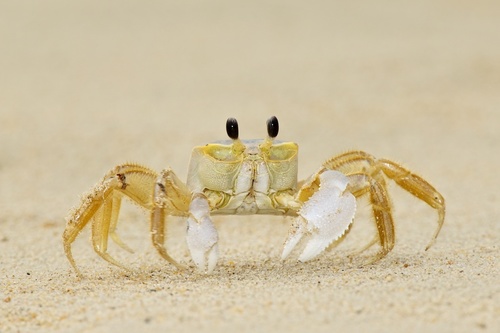
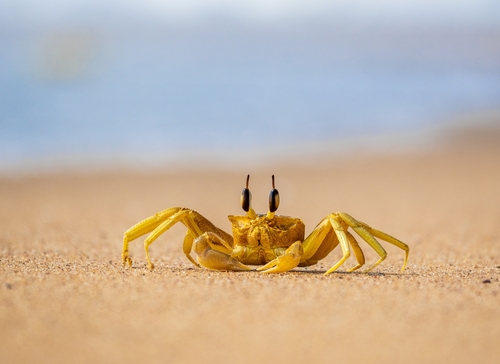
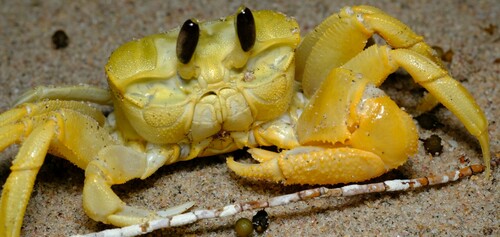
Golden ghost crabs (Ocypode convexa Quoy & Gaimard, 1824) are relatively large, robust ghost crabs with strong legs and claws. Their carapace is deep and box-shaped, reaching a maximum length of 45 mm (1.8 in) and maximum width of 52 mm (2.0 in). Their coloration makes them easy to identify: as their common name suggests, their overall body color is usually creamy white to a rich golden yellow with faint brown markings. Like other ghost crabs, golden ghost crabs have large, swollen eyestalks with the cornea on the lower surface. Unlike the similarly sized horned ghost crab (Ocypode ceratophthalma), which also occurs in Western Australia, the tips of golden ghost crab eyestalks do not extend into a spike (style). The upper margins of the golden ghost crab’s eye orbits curve around the bases of the eyestalks, then curve gently again toward the sides of the carapace. The outer edges of the upper margins of the eye orbits are triangular and distinctly point forward. The lower margins of the eye orbits have deep notches at the center and on the sides. The carapace is wider than it is long, and is broadest between the outer edges of the eye orbits. Its upper surface is densely covered in small bumps called tubercles, which become gradually sparser toward the anterolateral regions. The carapace bulges outward on its outer thirds, and is separated from the central regions by shallow furrows. Like other members of the family Ocypodidae, one claw appendage (cheliped) of golden ghost crabs is much larger than the other. This is true for both males and females, though the difference is far more pronounced in males. Both the larger and smaller chelipeds have outer palm (propodus) surfaces coarsely covered with large, irregularly arranged tubercles, giving them a rough texture. The larger claw is longer than it is wide; its upper and lower edges have rows of spine-like tubercles, arranged irregularly on the upper margin and regularly on the lower margin. The inner palm surface of the larger claw has stridulating (sound-producing) ridges in both sexes, a feature important for identifying different species in the subfamily Ocypodinae. In golden ghost crabs, the stridulating ridge is made of a row of 19 to 24 tubercles. The smaller cheliped tapers to a pointed end. The propodi of the first and second pairs of walking legs have bristles (setae) on their upper surfaces and upper margins, while the propodi of the third and fourth pairs of walking legs are hairless. The male’s first gonopod (an appendage modified into a sexual organ) has a three-sided cross-section at its base, and narrows toward a sideways-curving tip. A bulging palp is present on the sides near the tip. In females, the rim of the genital opening is horn-shaped, and sits in front of the genital covering (operculum), which is rounded in shape. Golden ghost crabs are endemic to the coast of Western Australia, ranging from Broome to Perth. They are one of five ghost crab species found along the Western Australian coast; the other four are Ocypode ceratophthalma, Ocypode cordimanus, Ocypode fabricii, and Ocypode pallidula. Of these, Ocypode fabricii is also endemic to Australia, ranging from Darwin to Shark Bay. Golden ghost crabs can be easily distinguished from all other species by their large size, golden yellow coloration, and rough tuberculation on their claws. The only similarly sized species in the region is the horned ghost crab, which is easily distinguished because it is the only ghost crab in Australia that has spikes (exophthalmy) on the tips of its eyestalks. Younger individuals can be identified by examining their stridulating ridges and gonopod shape. Like other ghost crabs, golden ghost crabs are mostly nocturnal, though they may sometimes emerge during the day. They are semi-terrestrial, and breathe oxygen from the air through moistened gills. They must periodically wet their gills with seawater, usually by taking water from moist sand or by running into the surf to let waves wash over them. However, in 1962 Australian zoologist William Ride reported golden ghost crabs foraging as far as 500 m (1,600 ft) inland from the sea after heavy rains. This indicates the species can tolerate freshwater, and can still breathe by absorbing moisture through wet vegetation. Golden ghost crabs must return to the sea to release their eggs, which hatch into marine planktonic larvae. Golden ghost crabs dig deep burrows in the intertidal and supratidal zones of open sandy beaches. Some burrows can be found as far as 12 to 20 m (39 to 66 ft) from the high water mark, in the dune zone, but burrows are densest in the intertidal zone, where 71% of them are found. Burrows are built vertically, and their bottom is most commonly located south of the entrance. This is thought to prevent sunlight from shining into the burrow during the day. Golden ghost crabs are fast runners, and dart into their burrows at the slightest sign of danger. When potential threats such as humans are nearby, golden ghost crabs have been observed raising only one eyestalk at a time, keeping the other protected inside its eye orbit. This may be to avoid damaging both eyes if an attack occurs. Golden ghost crabs are generalist feeders. They scavenge carrion and debris like dead fish or seaweed washed ashore, and also prey on small animals including molluscs, other crustaceans, and sea turtle hatchlings.