About Ocypode brevicornis H.Milne Edwards, 1837
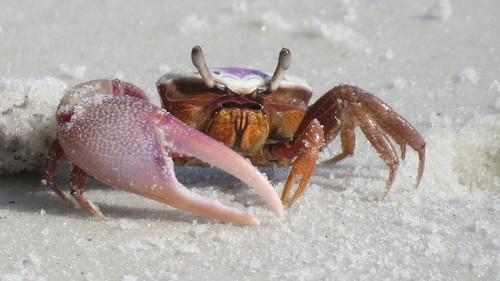
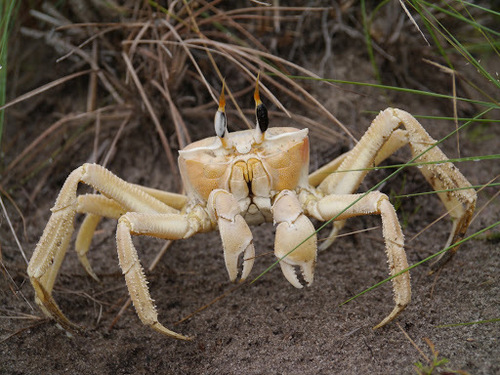
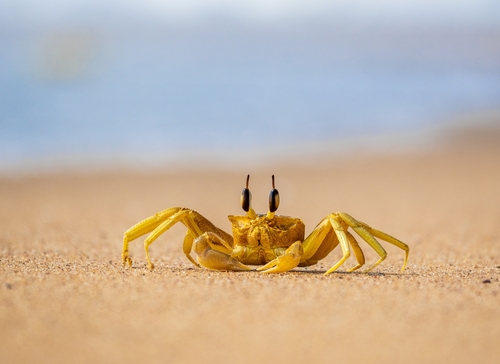
Ocypode brevicornis is a species of large ghost crab with deep bodies. In adults, the carapace ranges from 24 to 41 mm (0.94 to 1.61 in) in length, and 26 to 50 mm (1.0 to 2.0 in) in width. The carapace is almost trapezoidal, with the rear end distinctly narrower than the front; it is wider than it is long, and covered with scattered rough bumps called tubercles. The upper margins of the eye sockets slant forwards on the inner half and backwards on the outer half, and the edges of the eye sockets are rectangular. The eyestalks are large and swollen, with the cornea occupying most of the bottom half. Like some other members of the genus Ocypode, the eyestalks have small prolongations called styles at their tips. These styles may be absent or much shorter in juvenile specimens, as they only start growing when the crab is around 12 mm (0.47 in) in length. Like other ghost crabs, one of the claw appendages (chelipeds, the first pair of pereiopods) of Ocypode brevicornis is much larger than the other. The palm of the larger cheliped is long, with a rough bumpy texture on its upper surface. The upper edges of the palm are covered with small bumps, while the bottom edge is serrated. In both sexes, the inner surface of the larger claw’s palm has stridulating (sound-producing) ridges, a feature important for identifying different species within the subfamily Ocypodinae. In Ocypode brevicornis, the stridulating ridge is made up of a row of 23 to 28 tubercles. The smaller cheliped tapers towards a pointed end. The first gonopod (an appendage modified into a sexual organ) of the male is stem-like. Its base has a three-sided cross-section, and it ends in a slightly curving tip, with a broad and flat palp present. The operculum (covering) of the female genital opening is oriented lengthwise, with a thick straight rim that slants backwards. Adult Ocypode brevicornis have a mottled yellow to brown coloration. Males often have brighter yellow coloring, especially on their legs. Juveniles have almost perfect cryptic camouflage, making them very hard to distinguish from their surroundings. Ocypode brevicornis is restricted to the Indian Ocean. It can be found from the Gulf of Oman to India, Sri Lanka, and the Nicobar Islands, and it is one of six ghost crab species found in the Indian subcontinent. The other five species are Ocypode ceratophthalma, Ocypode cordimanus, Ocypode macrocera, Ocypode pallidula, and Ocypode rotundata. Like other ghost crabs, Ocypode brevicornis lives in deep burrows near the intertidal zone of open sandy beaches. It is a generalist feeder, scavenging carrion and debris as well as preying on small animals. It is primarily nocturnal, though it may emerge during the day. It is a swift runner, darting back to its burrows at the slightest sign of danger, even when an intruder is still 30 ft (9.1 m) away. It can be approached much more closely at night, though it will still usually try to escape if illuminated. Male Ocypode brevicornis perform elaborate territorial displays. Like other ghost crabs, they produce sound and vibration by rapping their larger claw against the ground. They may also perform dances when another ghost crab approaches. Starting from a rearing posture, males carry out increasingly complex sideways movements that end with them running in circles around the intruder until the intruder retreats.