About Octopus vulgaris Cuvier, 1797
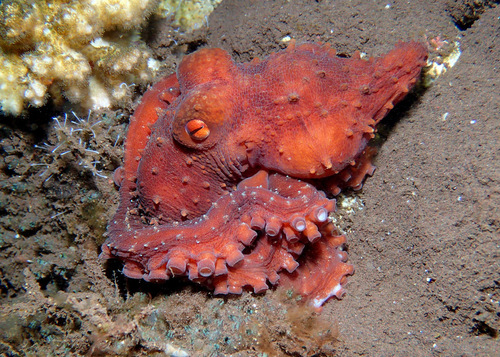
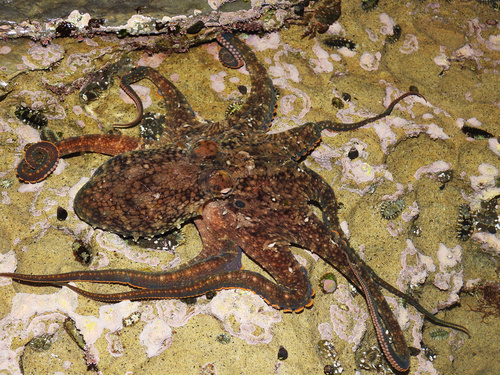
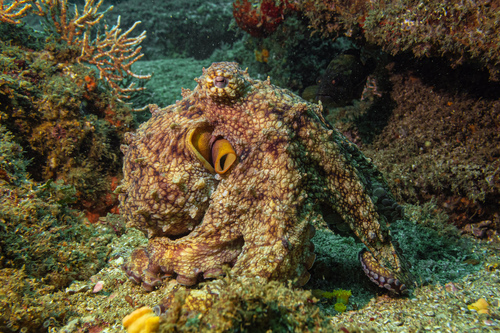
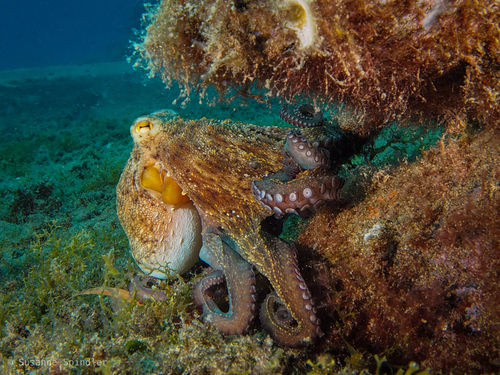
Common octopus, scientifically named Octopus vulgaris Cuvier, 1797, can grow up to 25 cm (10 inches) in mantle length, with arms reaching up to 1 m (3.3 feet) long. It has a lifespan of 1 to 2 years and may weigh up to 9 kg (20 pounds). Cannibalism may occur during mating. O. vulgaris is caught in large quantities by bottom trawls off the northwestern coast of Africa, with more than 20,000 tonnes (22,000 short tons) harvested annually.
The common octopus hunts at dusk. It prefers to eat crabs, crayfish, and bivalve mollusks (such as cockles), though it will eat almost any prey it can catch. It can change its body color to blend into its surroundings, allowing it to ambush unsuspecting prey that crosses its path. It uses its hard beak to crack open the shells of mollusks, and it has venom to subdue its prey.
O. vulgaris has evolved a large nervous system and brain, with around 500 million neurons across its body, a count close to that of dogs. It is intelligent enough to distinguish brightness, navigate mazes, recognize individual people, and learn to unscrew jars or raid lobster traps. It has also been observed maintaining "gardens", where it collects different marine plants, algae, shells, and rocks; this behavior is thought to have inspired the 1969 Beatles song title "Octopus' Garden". In the United Kingdom, O. vulgaris was the first invertebrate protected under the Animals (Scientific Procedures) Act 1986. Training experiments confirm that the common octopus can also distinguish between object size, shape, and horizontal or vertical orientation.
The common octopus is distributed worldwide across tropical, subtropical, and temperate waters. It prefers the relatively shallow, rocky seafloor of coastal areas, most often no deeper than 200 m (660 feet). While it prefers a salinity of around 36 grams per liter, it can be found in habitats with salinity ranging from approximately 30 to 45 grams per liter. It encounters a wide range of environmental temperatures, but its preferred temperature range is 15 to 16 °C (59 to 61 °F). During particularly warm seasons, the octopus often moves deeper than its usual range to avoid warmer surface water layers.
When moving vertically through the water column, the octopus experiences varying pressure and temperature conditions that change the concentration of available oxygen in the water, following Henry's law, which states that the concentration of a gas in a substance is proportional to pressure and solubility, with solubility influenced by temperature. These fluctuations in oxygen availability require the octopus to have regulatory methods for oxygen intake. The octopus most often stays in shelters where only a minimal portion of its body is exposed to open water. When it does move, it usually crawls along the seafloor, where its underside still remains obscured. Crawling greatly increases its metabolic demands, requiring roughly 2.4 times the oxygen intake of a resting octopus. This increased demand is met by an increase in the stroke volume of the octopus's heart.
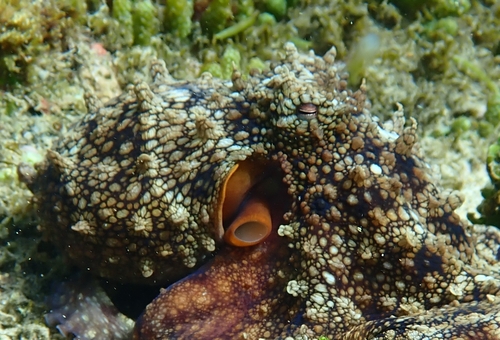
Occasionally, the octopus swims through open water, exposing its entire body. For swimming, it uses a jet propulsion mechanism that builds high pressure in its mantle cavity to propel itself forward. Since the common octopus's heart and gills are located inside its mantle, the increased pressure also constricts the blood vessels returning blood to the heart, causing circulation problems. Swimming is not a sustainable form of movement for the octopus, because it cannot take in enough oxygen to meet the metabolic demands of this strenuous activity.
In the studied region, spawning of O. vulgaris occurs from December to September, with a distinct peak in the spring months.